


Nesting
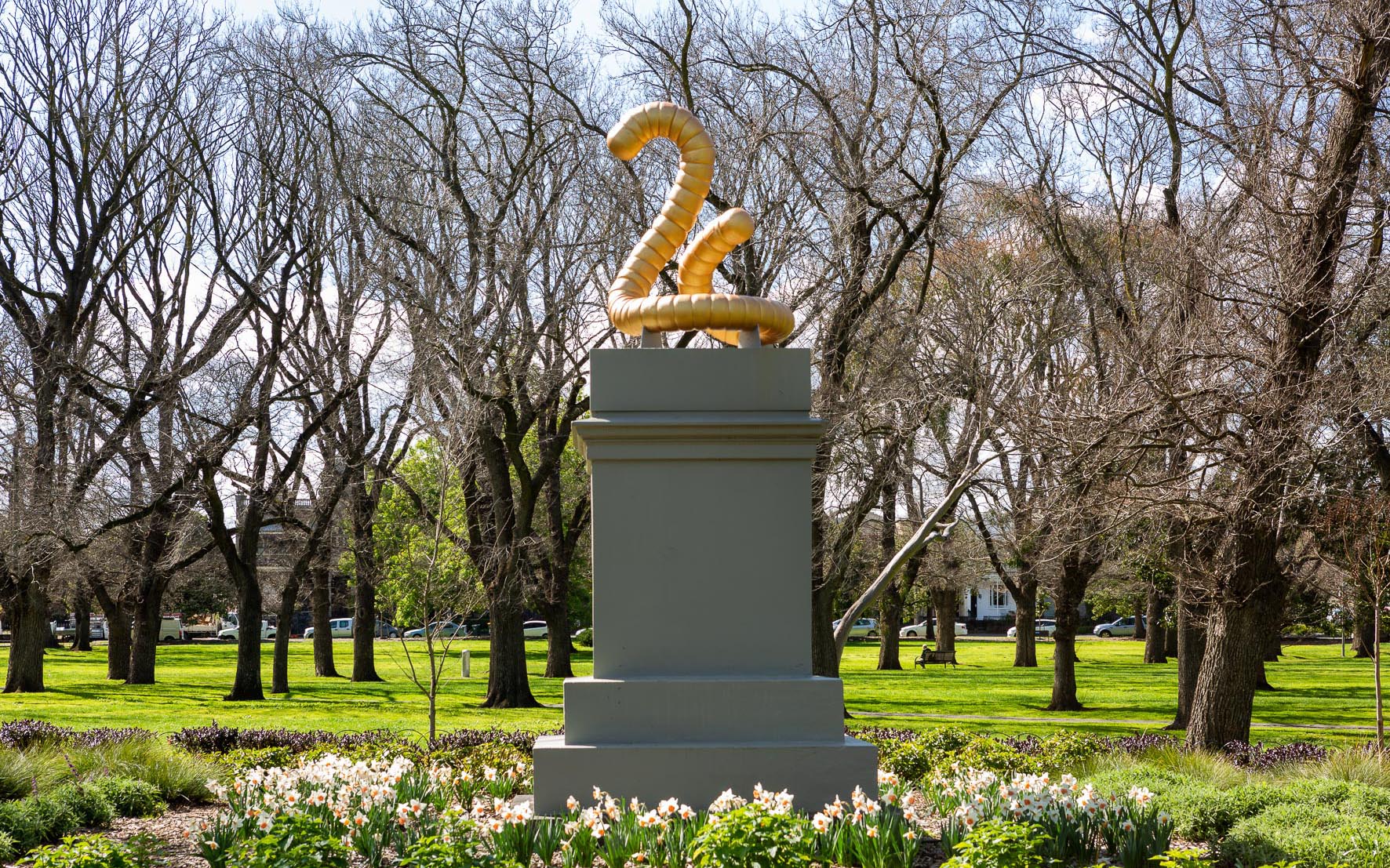
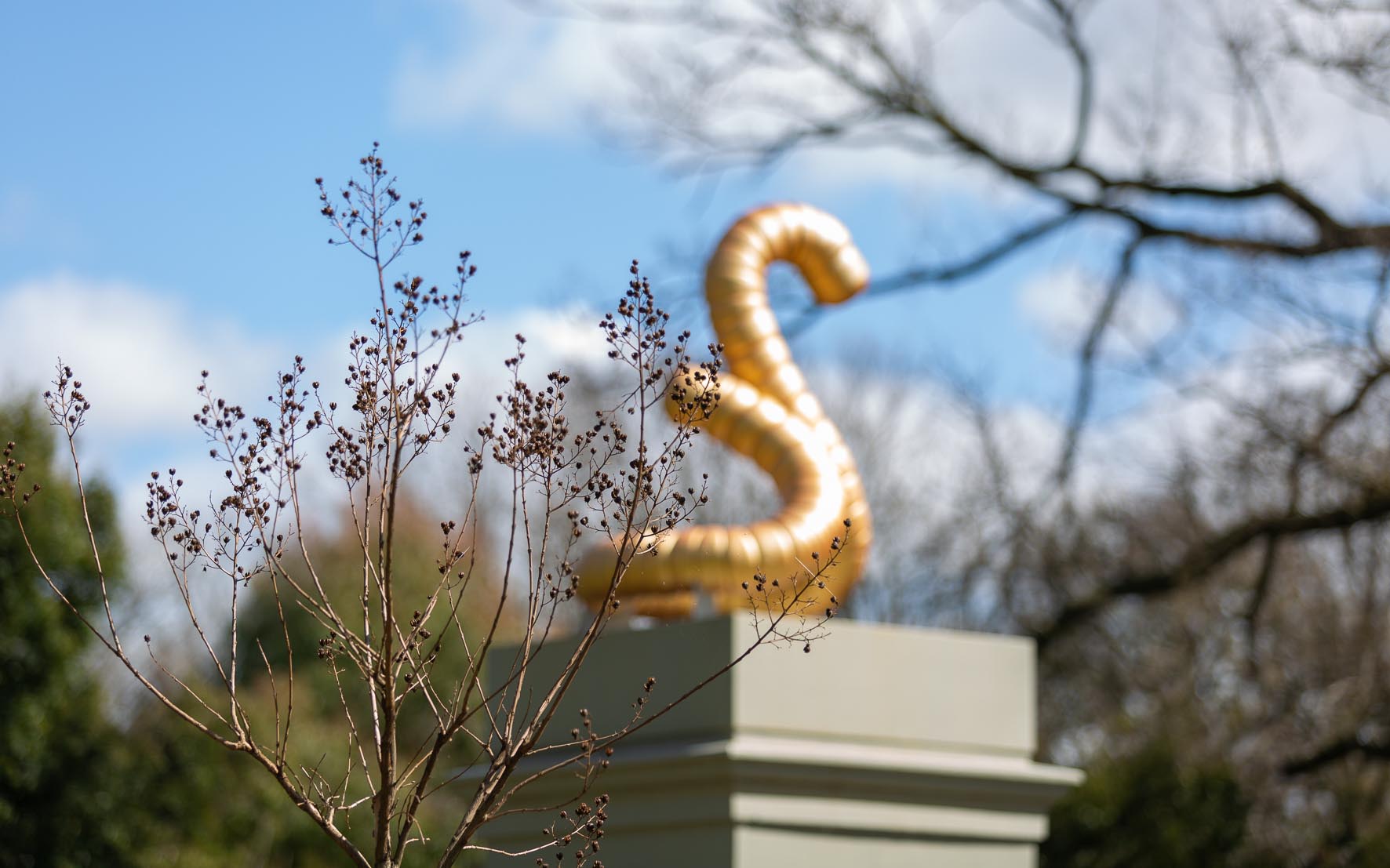
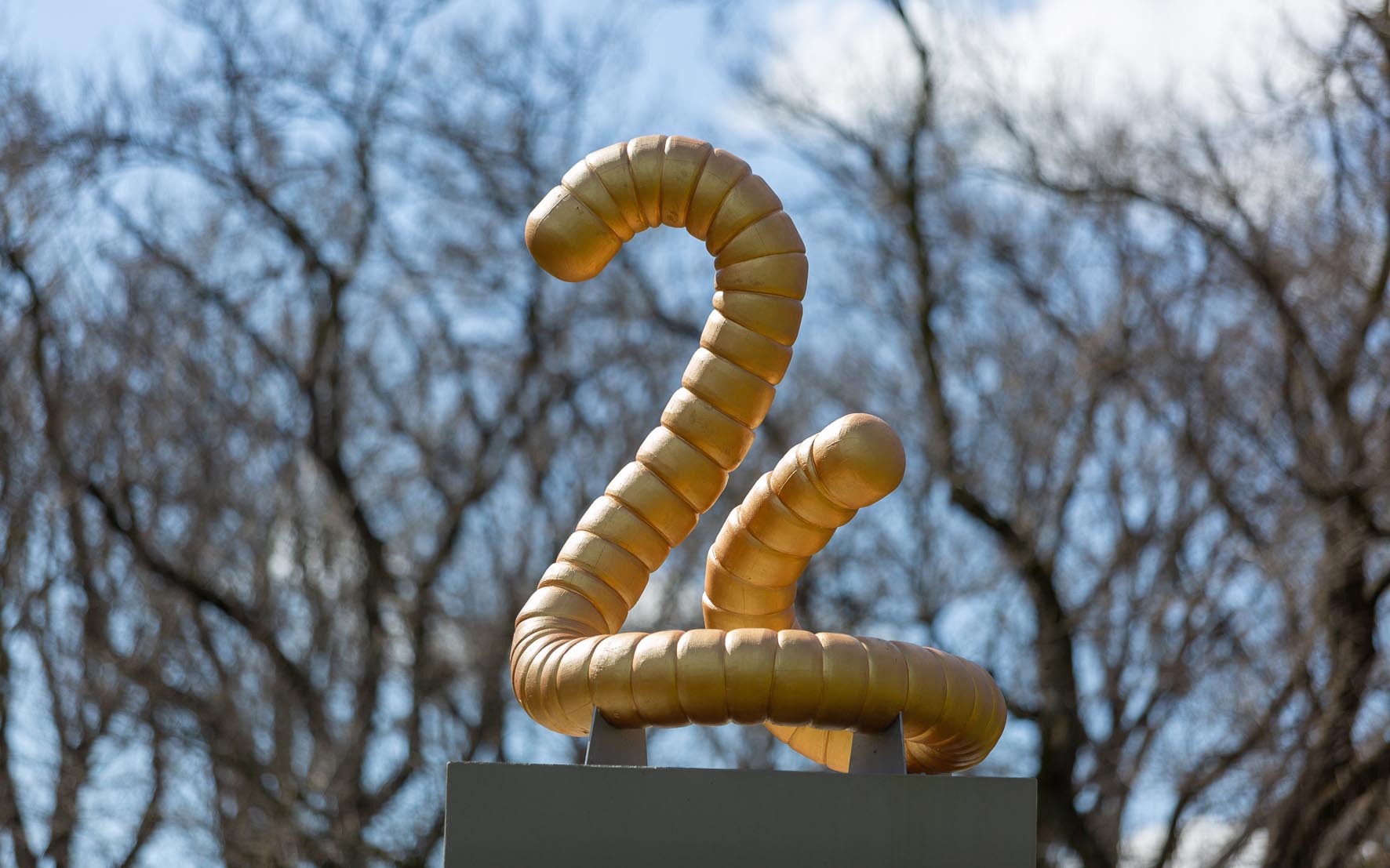
This sculpture sits proudly on the plinth in the Intercultural Gardens in Ballarat. The site honours our multicultural society but I also wanted to include our multi-species community within this. The forms represent the idea of ‘home’ and are based on the domed shaped nests of local fairy wrens. It is community of nests and each one reflects the importance of home. Home is a feeling. Ideally home is a place of comfort, safety and gives us a sense of belonging. I’ve been thinking about the word Eudaemonia which I’ve interpreted to explain a deep sense of fulfilment and flourishing by cultivating a purposeful and nourishing life. It’s beyond hedonism or material success but a deep sense of fulfilment by living in harmony with one’s own ethics. I almost named the sculpture after this idea but went with the more easily relatable name ‘Nesting’.
Located on the corner of Sturt and Pleasant Streets Ballarat until June 2026.
MAV ARTICLE: https://www.mav.org.au/news/announcing-kathy-holowkow-ballarat-plinth-project
Images and footage by Daniel Williams @mossy.rock.photography
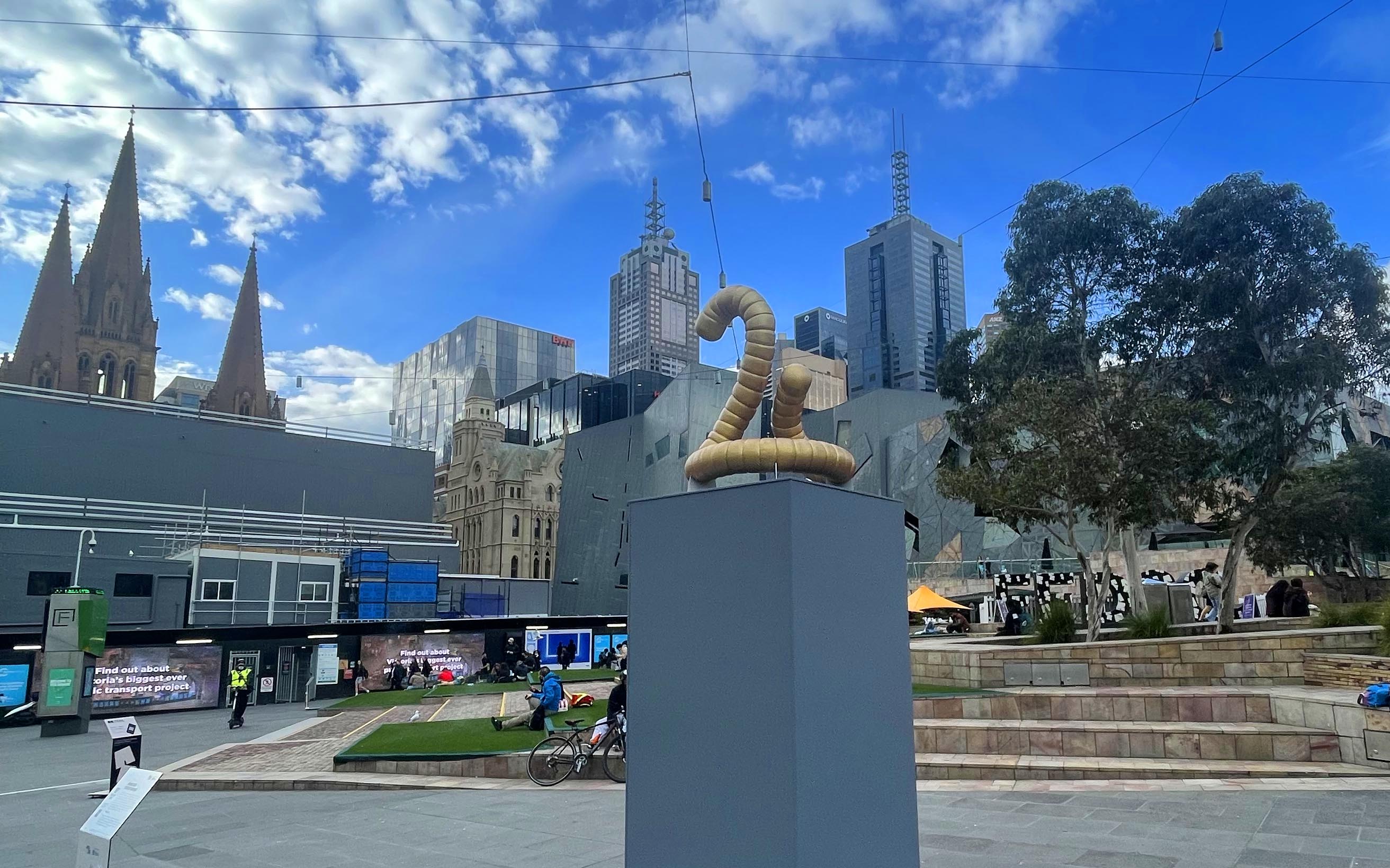
City of Yarra Plinth Project
The Unsung Hero
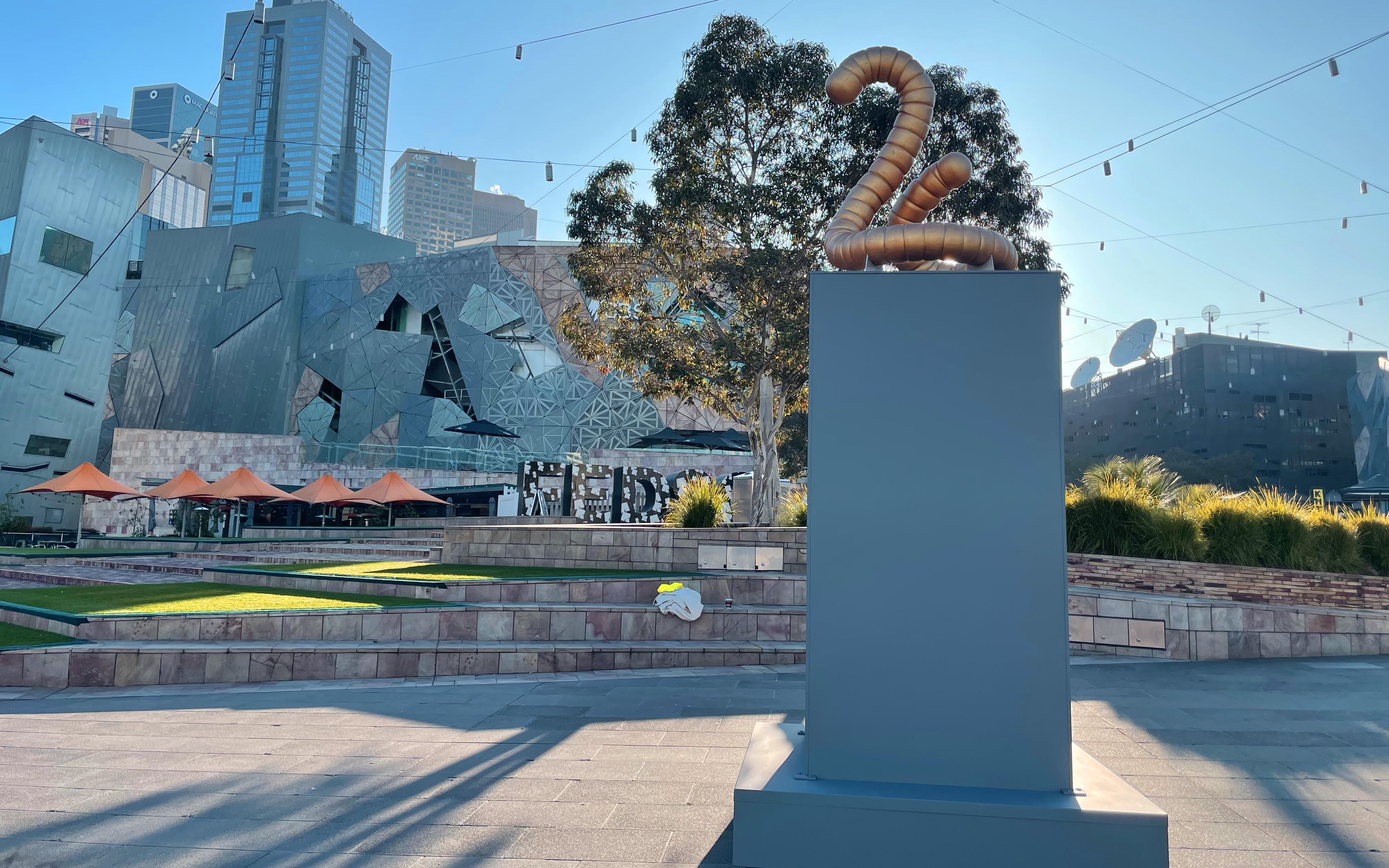
- 2019 / Wood, steel, paint / Photograph by J. Forsyth / City of Yarra Plinth / Federation Sq
A plinth is an historical site for the revered, those we are told to remember and admire. The playful juxtaposition between this cultural structure of the plinth and the placement of the humble earthworm—raised up on a pedestal and represented on a momentous scale—is humorous and yet deeply meaningful. Silently in darkness the earthworm has been going about its business, doing the important and under-rated work of turning decaying matter into nutrients for plants. It is one of the hardest working and most unrecognised members of our biotic community. Their burrows bring water and air deep into the ground providing the right conditions for root growth, creating the healthy soil that we all depend on. I believe it is time that we honoured this unsung hero, and raise the earthworm up onto the plinth. It is a reminder of our dependence on ecological cycles, the importance of composting our green waste and to think about the lifecycles of the matter that we consume.
The offical launch and Worm Party was held on the 20th of October 2019. The Gould League held a free worm composting session and information stall on the day, and lots of other worm activities. The event was launched by the Mayor of Yarra with a speech by Dr Tessa Laird.
ABC RADIO conversation – (includes Permaculture founder David Holmgren comenting on the Unsung Hero)
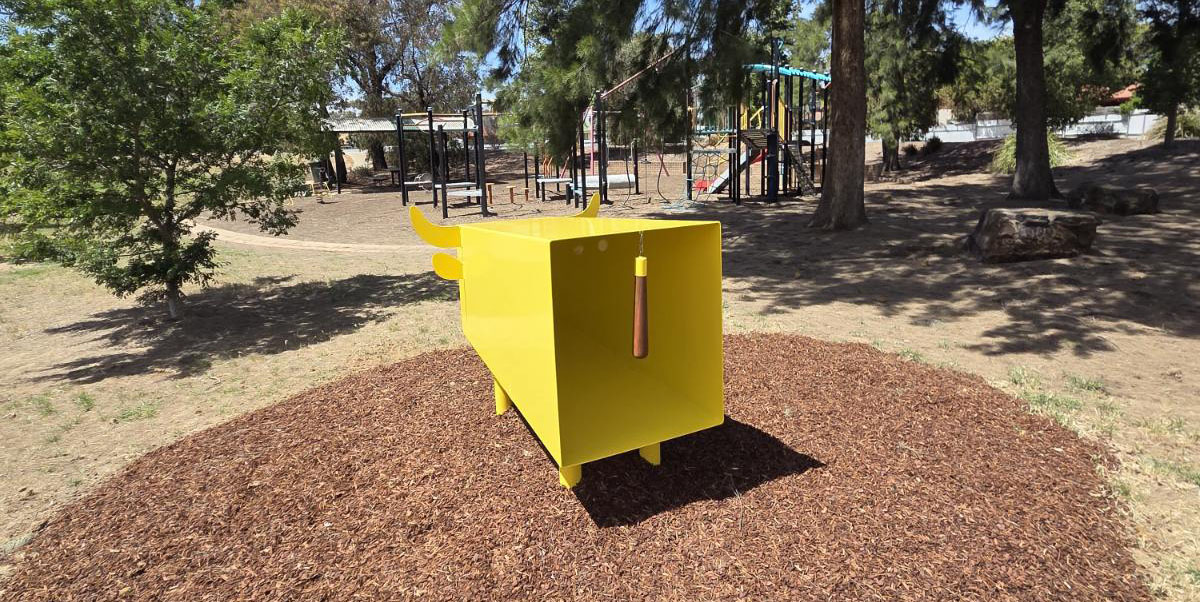
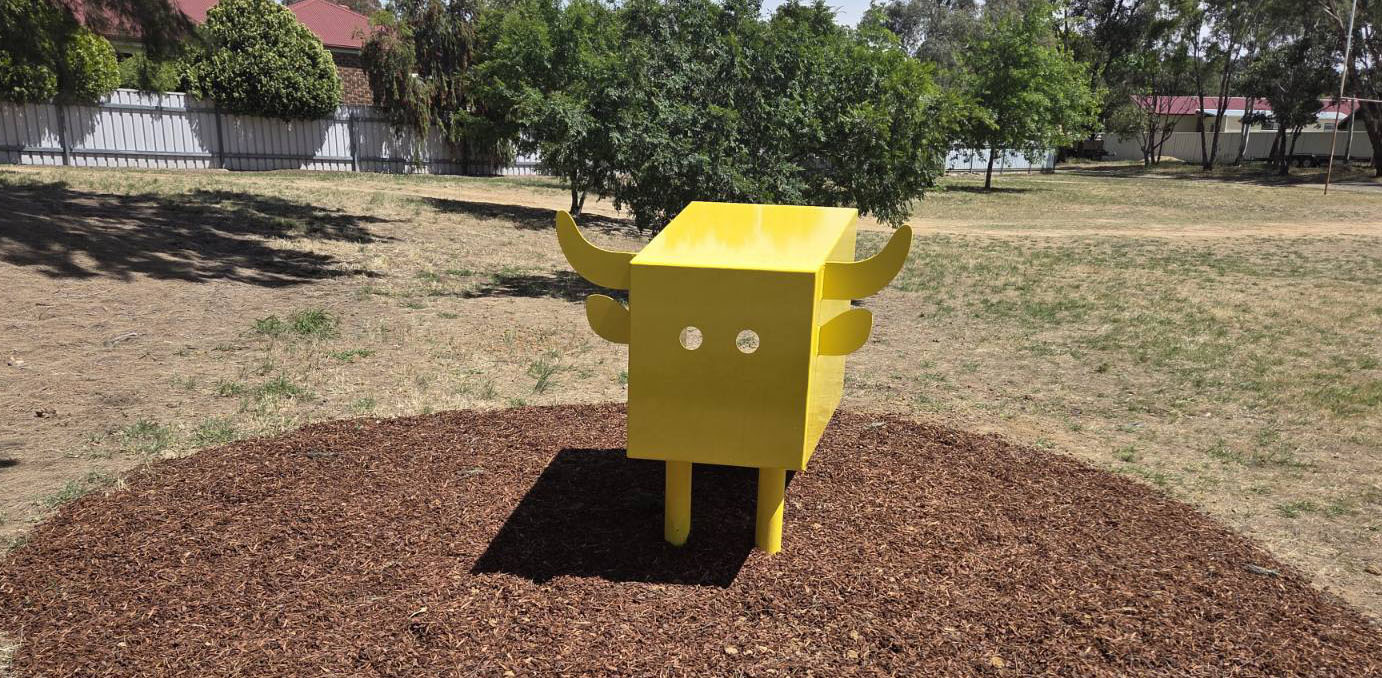
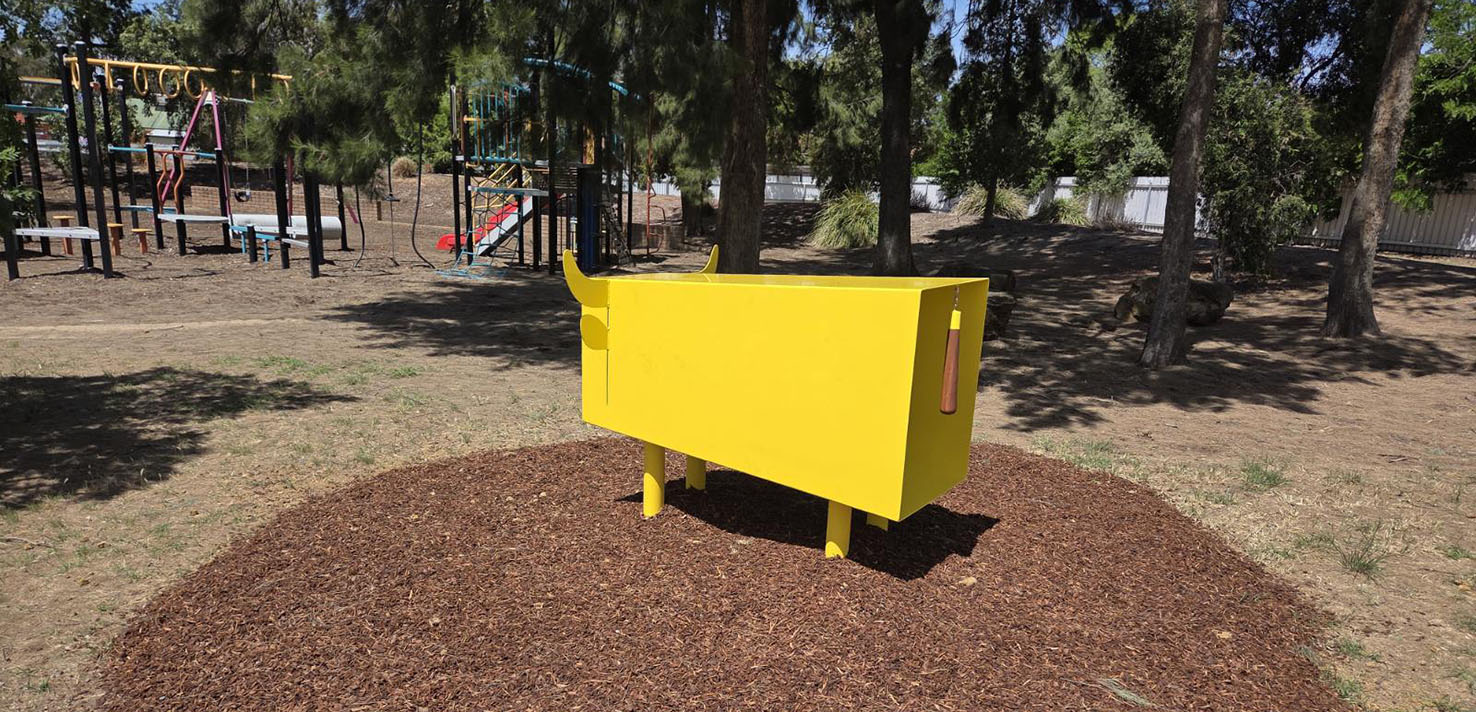
The Bullock Bell
The Bullock Bell sculpture was produced to celebrate the namesake of the park it appears in. It is based on an upturned bullock bell with the addition of a face and tail. It is a playful work located next to a playground that can be climbed in and played with. It has eye holes cut out for children to look through and its tail serves as the donger for the bell.
August Menneke was a very famous local blacksmith in the 19th century. He was famous for his well made and resonate bullock bells. Born in Bakenem, Germany he immigrated to Australia and served an apprenticeship in the blacksmithing trade, he established his own business in North Wagga, next to the Black Swan Hotel. His bells became famous as his bells had a clear tenor quality, which could be heard miles away. These bells were used on a leader in a bullock team or on other stock so they could be easily located. According to legend, a test was carried out on top of Mt. Kosciusko to find the best bell maker in Australia. The two rivals were August Menneke and Anthony Mongan of Albury. Menneke won when his bell could be heard ten miles away. Until the 1860s most pastoralists in the Wagga region transported their wool by bullock train to Sydney. Later, many sent their wool by steamer down the Murray to South Australia and then by train to Melbourne. When the railway line was extended to Wagga in 1880, the heyday of the bullock team was over. (source: migration heritage nsw).
Located permanently in Menneke Park Estella, Wagga Wagga
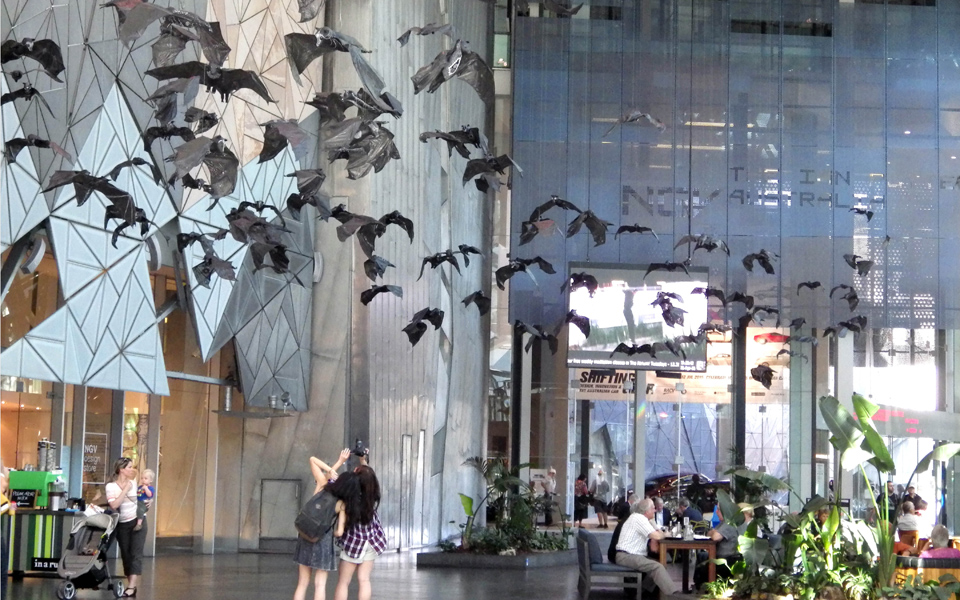
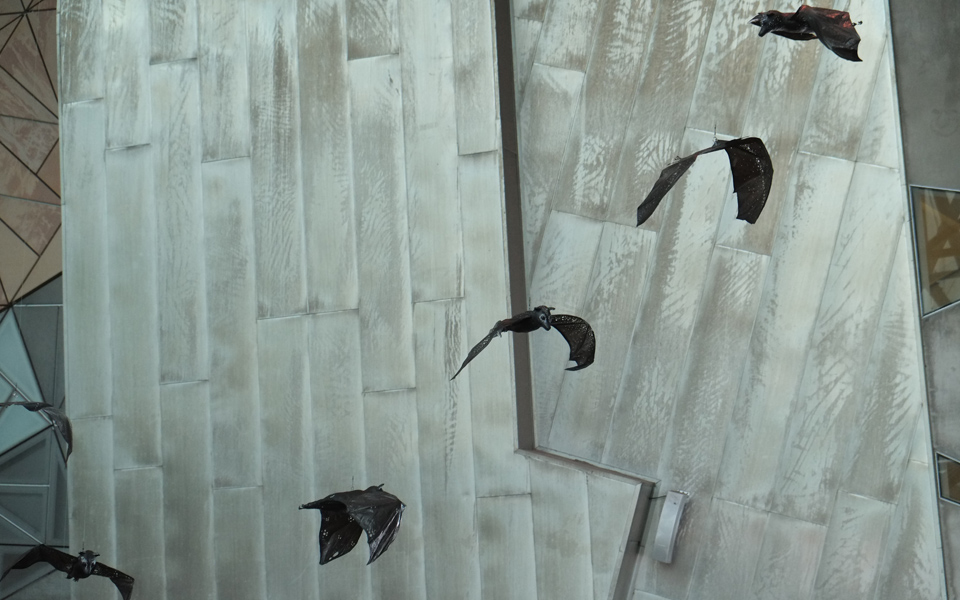
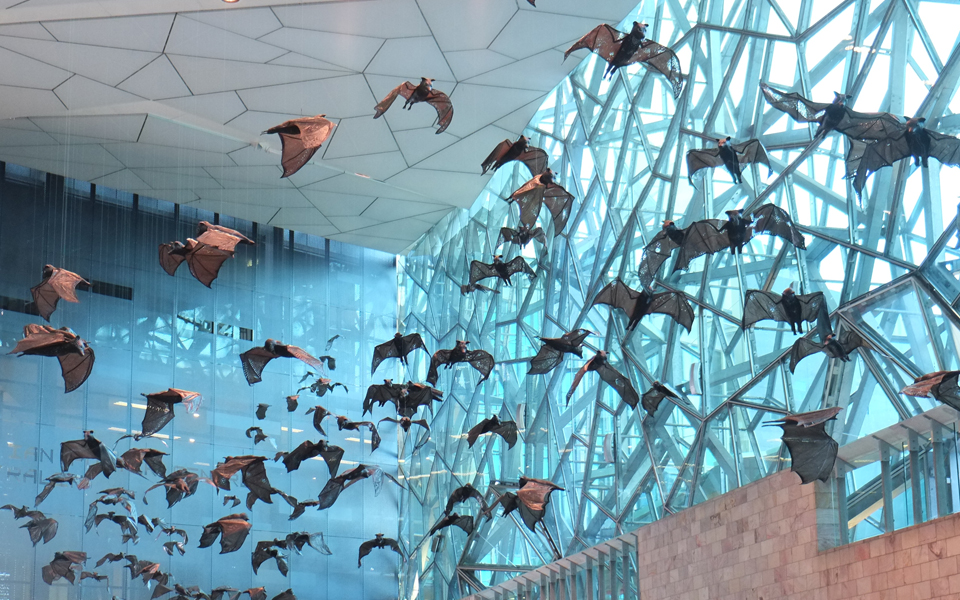
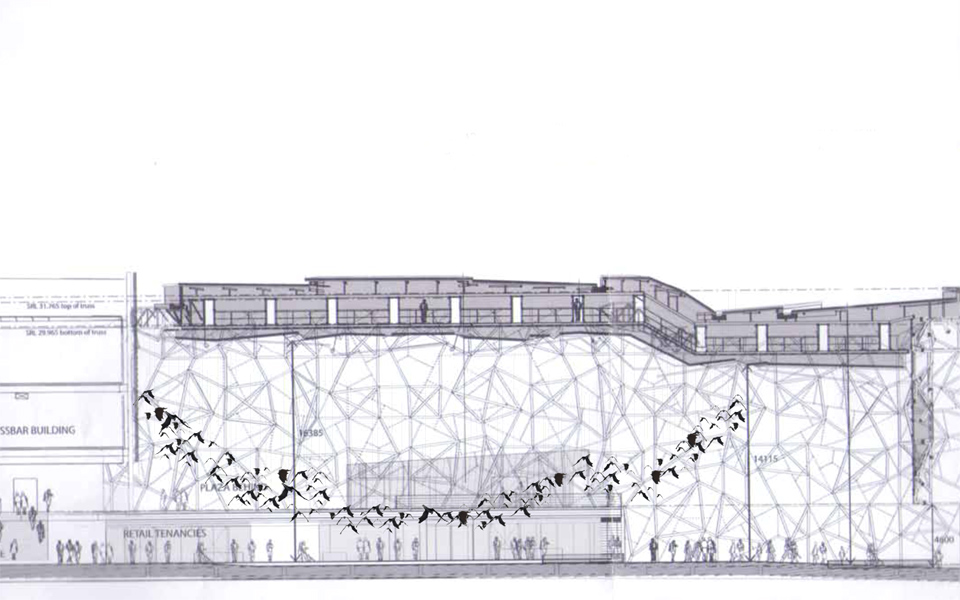
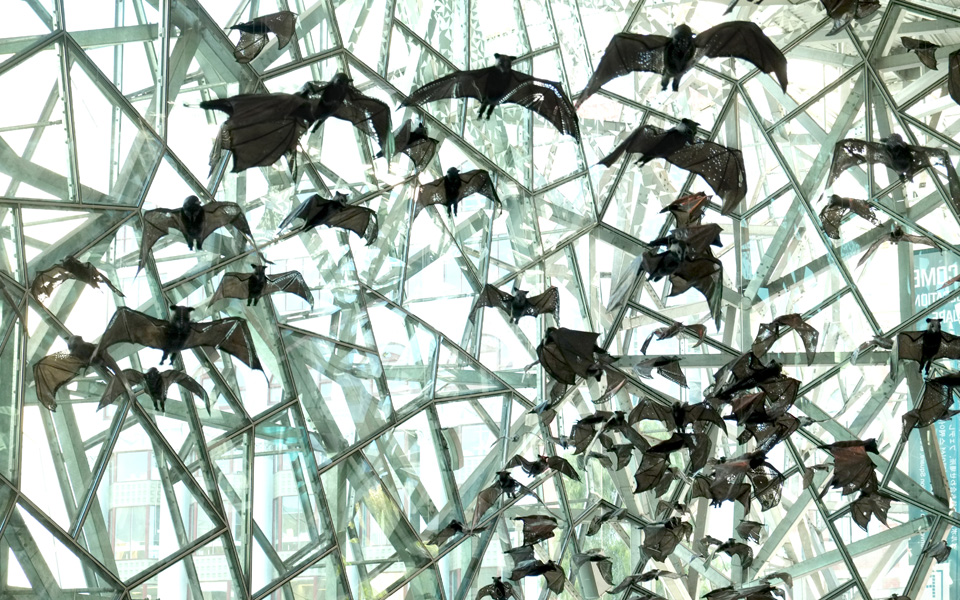
Batmania

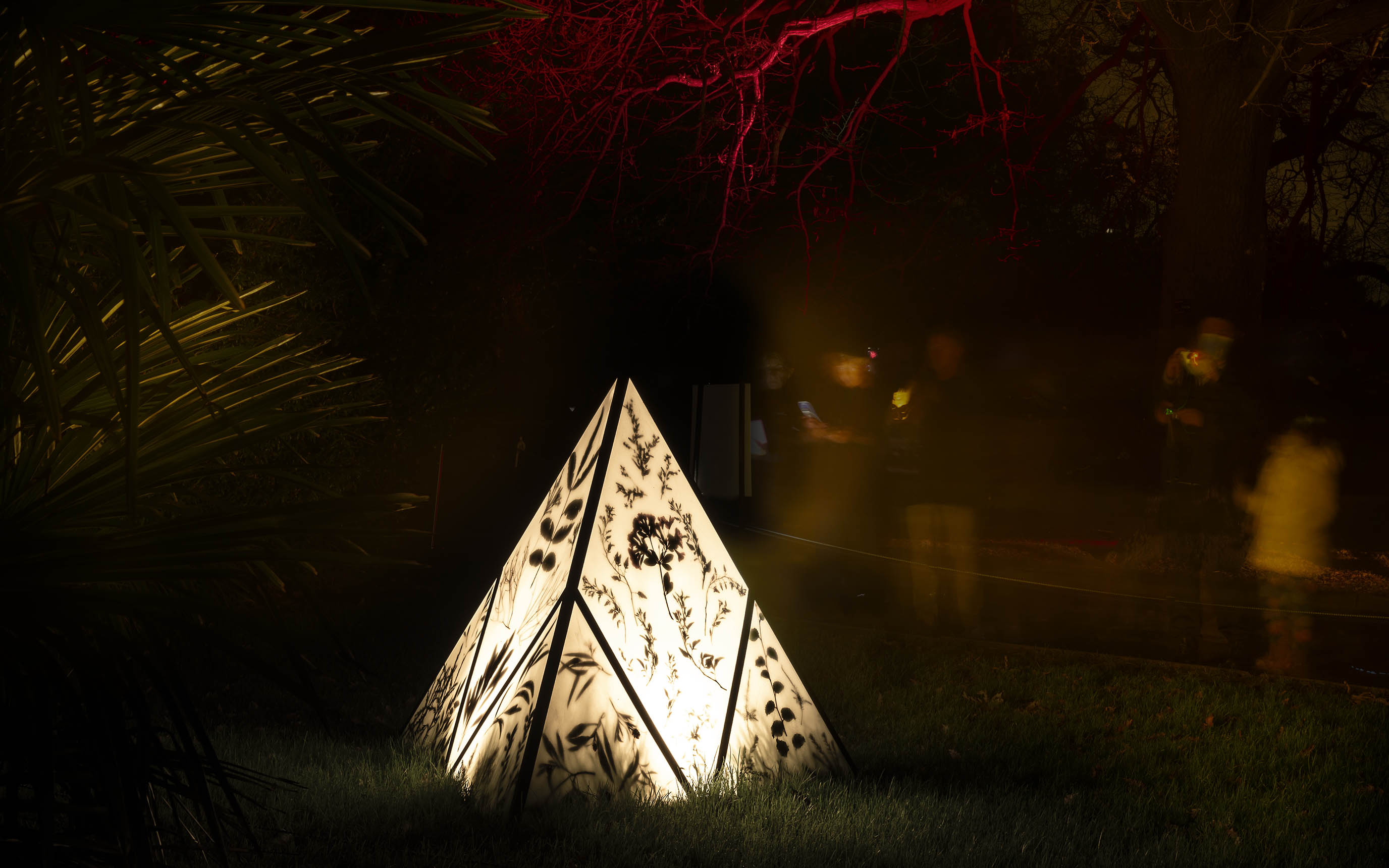
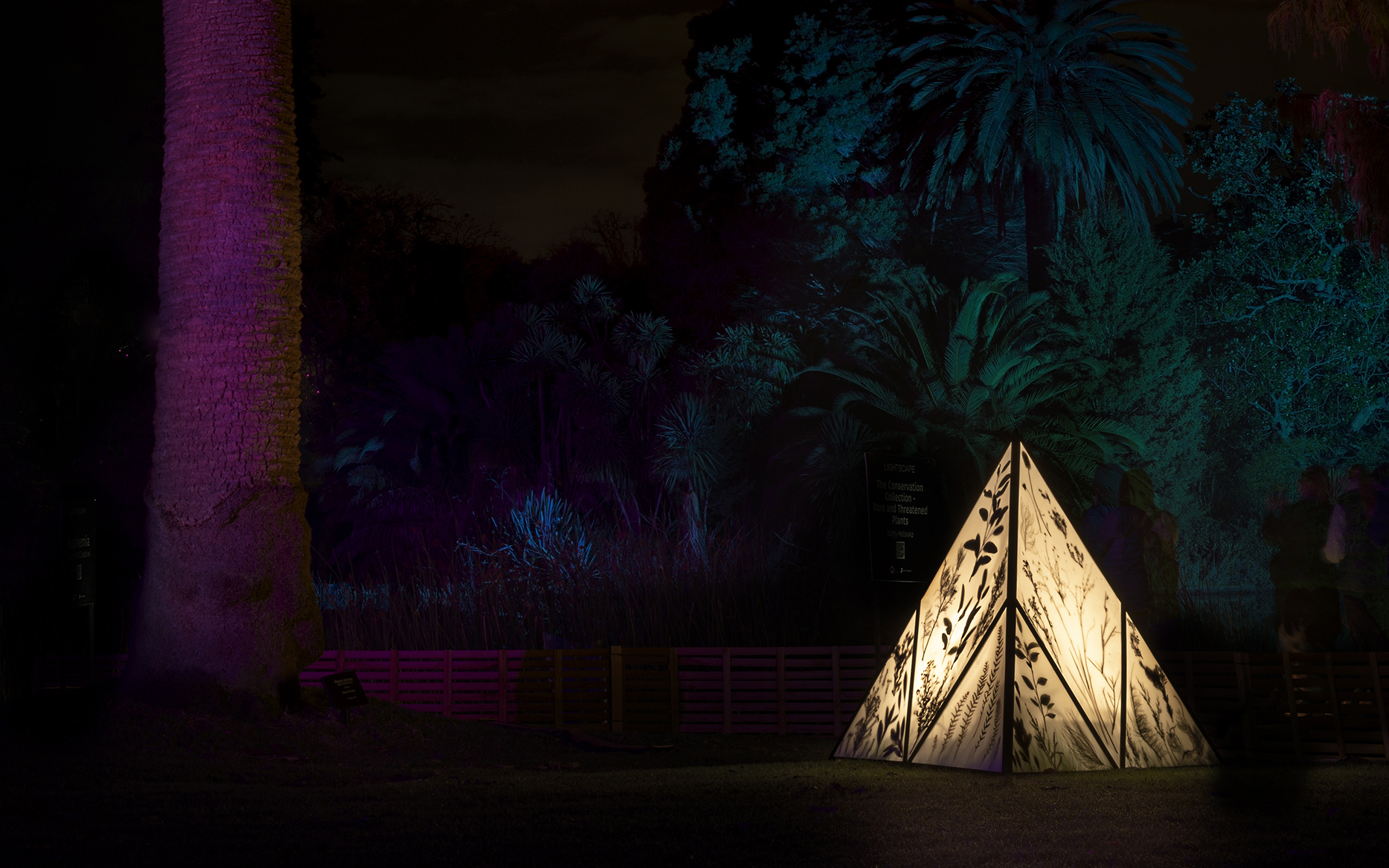
Botanical Lanterns
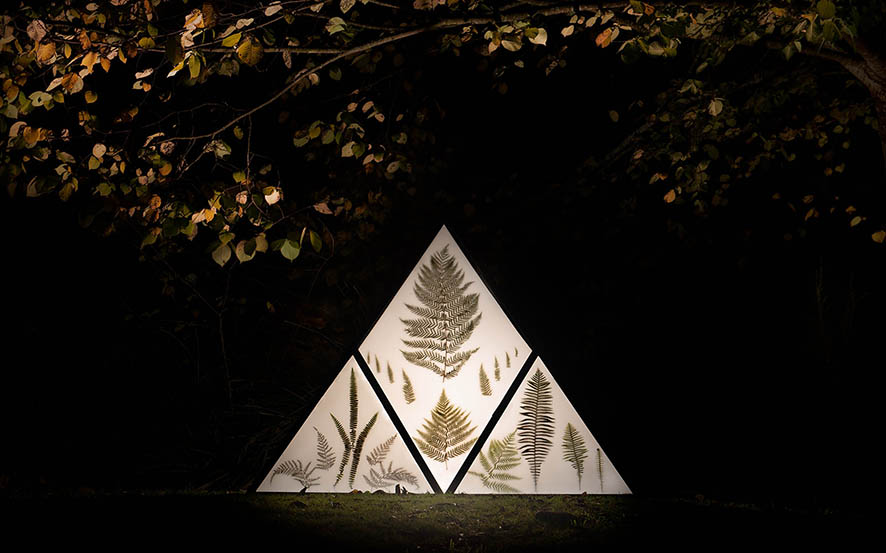
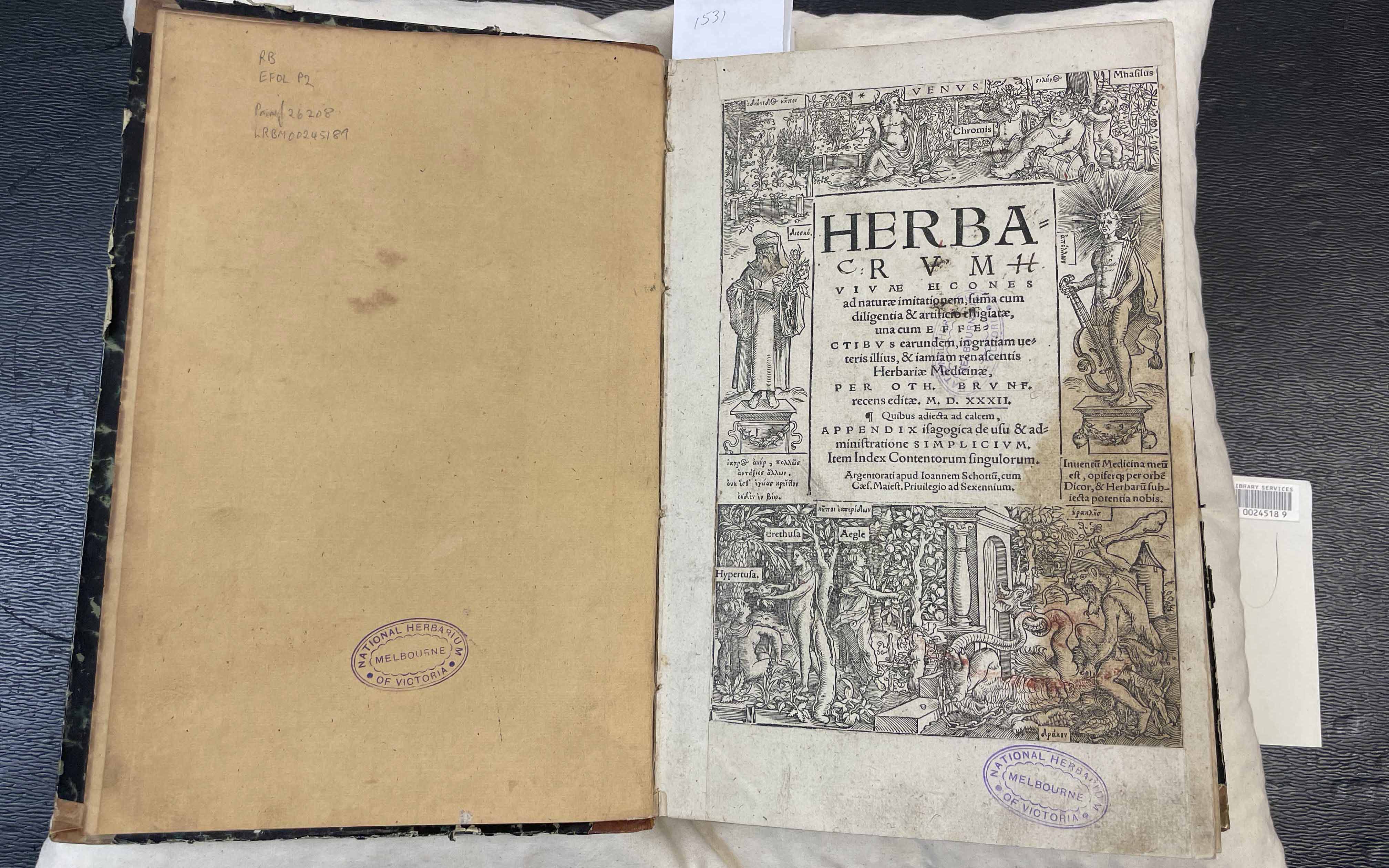
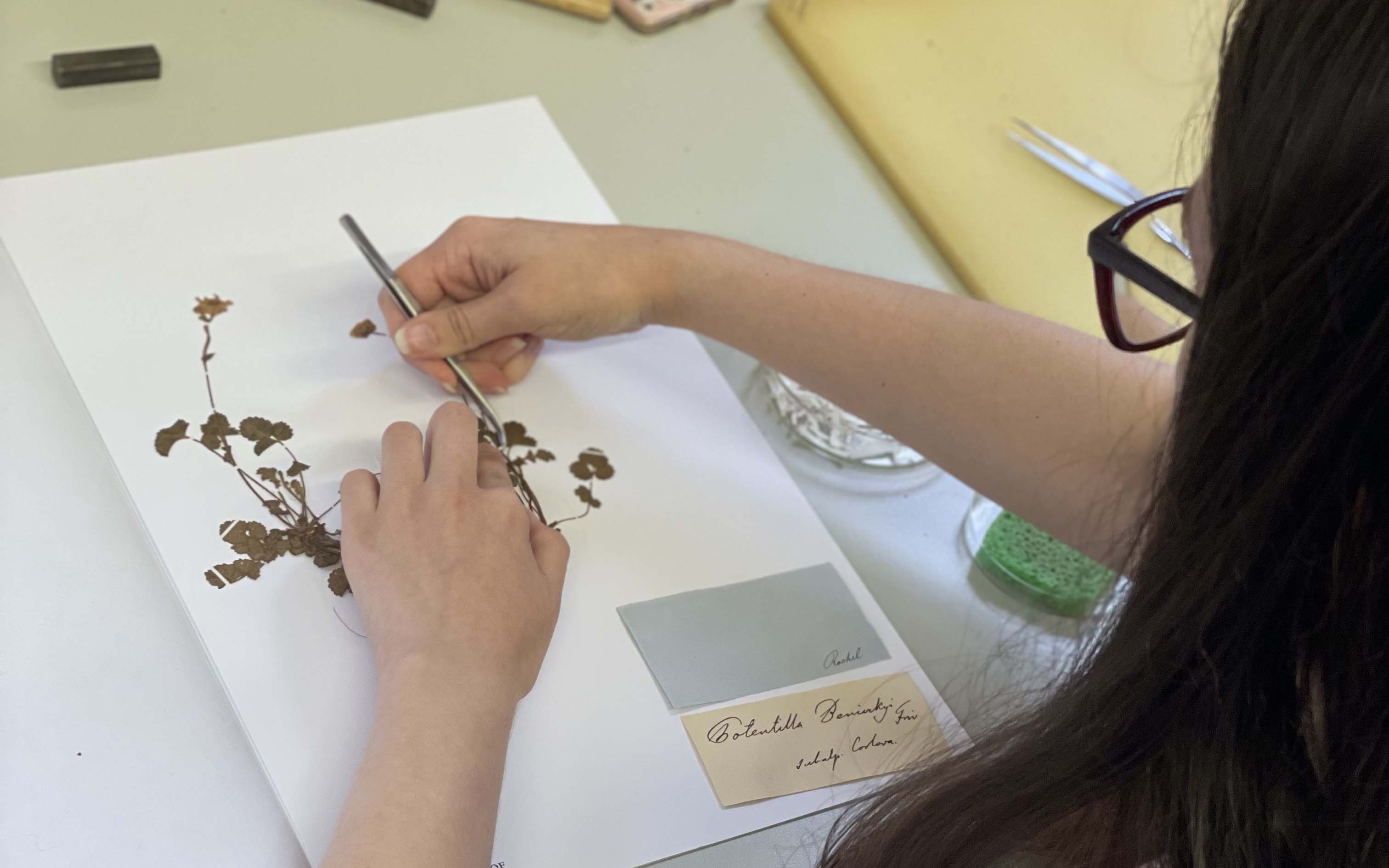
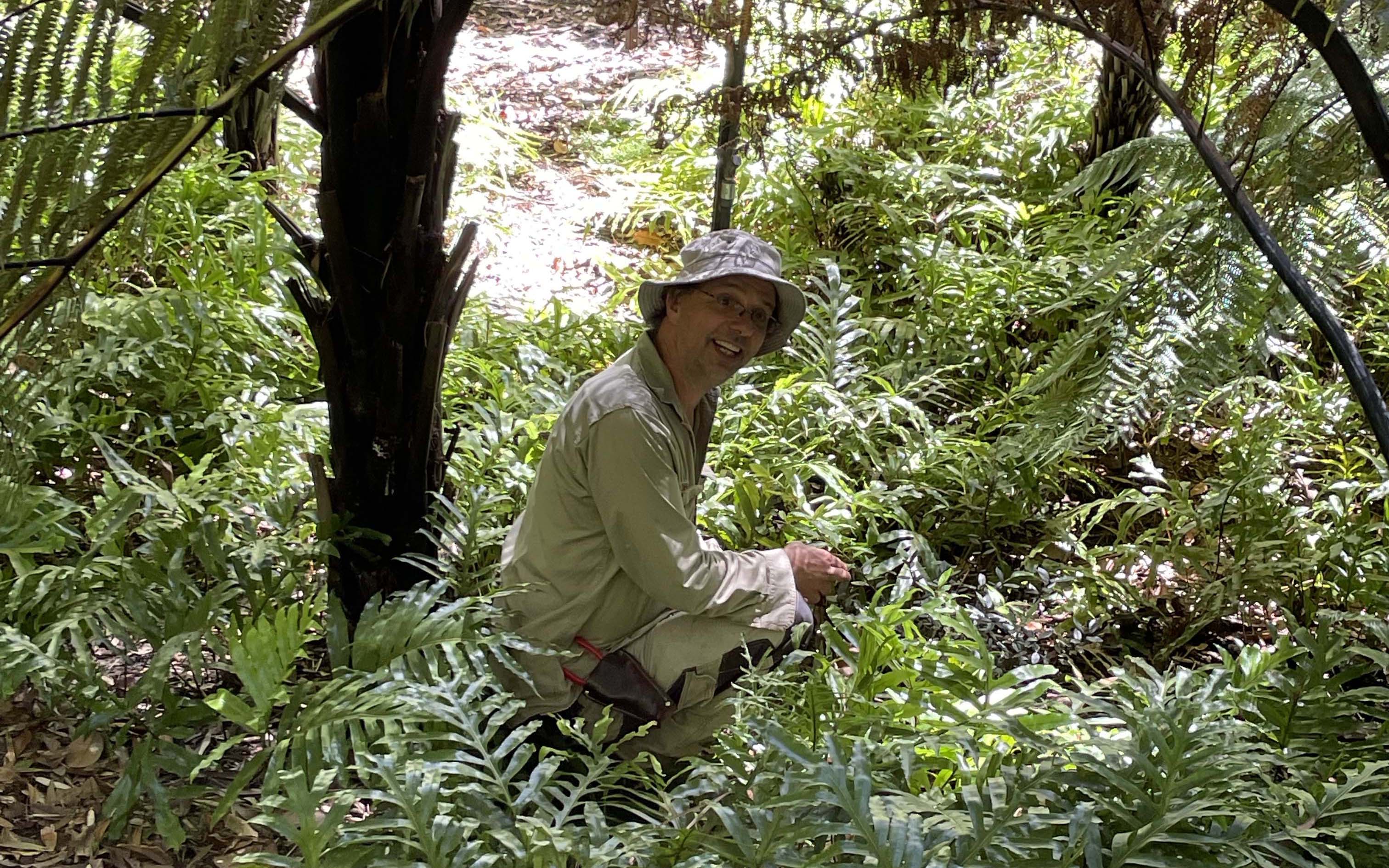
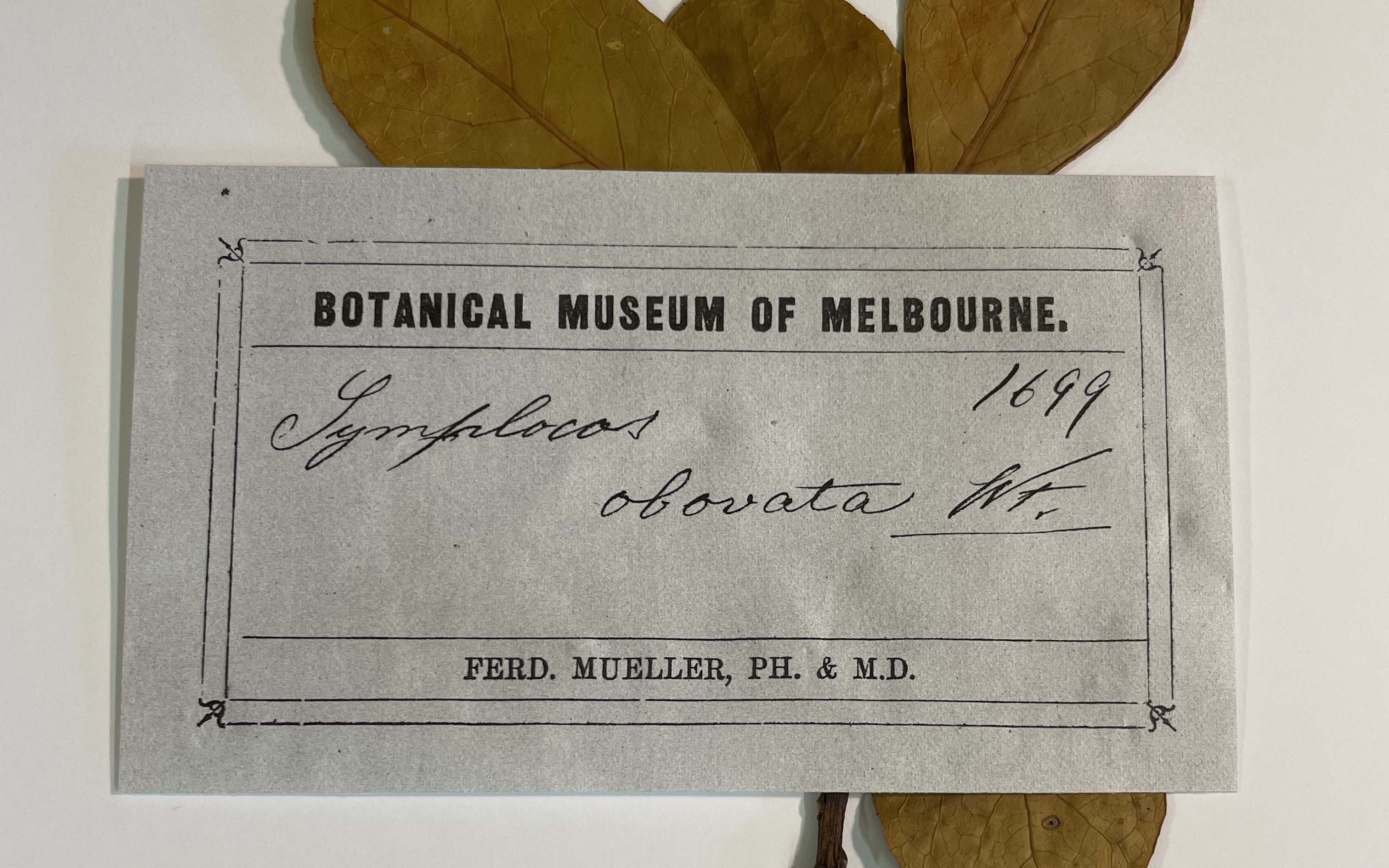
- Botanical Lanterns / 2022 / Royal Botanic Gardens Melbourne / Steel, bio resin, pressed and dried botanicals / Photograph at Lightscape by Daniel Williams / Photographs of the Herbarium Kathy Holowko
ILLUMINATING THE HERBARIUM – ROYAL BOTANICAL GARDENS
I have been lucky enough to be welcomed to the inner workings of the National Herbarium of Victoria, and guided through the aged folders with calligraphic writing on sepia-stained labels. The time-weathered folders contain dried and pressed botanical specimens, tied together with fabric ribbons. Each one is like opening a gift. As I peer over these collections I imagine the treacherous field trips of early explorers travelling through exotic landscapes, in ships and across time. The centuries-old contents of these folders gets carefully eyed by curators skilled in deciphering the collecting information. They forensically search for characteristics that assert or deny the handwritten notations that accompany each specimen. Sometimes they come with handwritten letters from the collectors that help to pinpoint where and when a specimen was collected, and to understand the context in which it was collected. The letters are also fascinating time capsules that reflect the language, societal attitudes and science of their time … along with exceptionally beautiful handwriting. The pressed and dried plants get carefully re-housed on fresh archival papers, photographed, catalogued and filed within the multiple floors of Herbarium cabinets. This is a botanical library. A preserved record of the vegetation of the earth. The seemingly endless and exacting task of recording these specimens is testament to the astonishing variety and beauty of plants, fungi, algae, lichen and moss in this collection … and our world. The Herbarium underpins all other botanical science and is used primarily by researchers and botanical scientists as a definitive source of information to understand plant taxonomy, anatomy, geography and history.
“The role of science like that of art, is to blend exact imagery with more distant meaning, the parts we already understand with those given as new into larger patterns…” Edward O Wilson
When evolutionary biologist Edward O Wilson describes Biofilia he reaches through a tapestry of culture and science to explain our deep biological connection to the natural world, and reminds us of this knowing and feeling in exact and poetic terms. The Herbarium and horticulture team that I encountered in this journey quietly share this deep wonder for nature through their dedicated appreciation of the minute and intricate details of the plants that they care for. If Biofilia can describe the very essence of our humanity and that which binds us to all living things, it concludes that a conservationist ethic naturally evolves from dedication to this empathetic knowledge. As we move further into the Anthropocene the resources and knowledge of places like the Herbarium will provide the backbone to the important work of adaptation.
When I learnt that succession planting is underway, it was a shock. The realisation that plants are being selected for Royal Botanic Gardens Victoria (RBGV) to prepare for a hotter, drier climate made this future very real. It was a familiar feeling from long ago when I learnt about the Millennium seedbank: a storage of the world’s botanical diversity to mitigate extinction and disaster. The work of conservation is both utopian and dystopian, hopeful and apocalyptic. I am very thankful for the balancing weight of our pragmatic scientists.
Art, like science, is a doorway into history, culture and evolution. I have stepped through the doorway of the Herbarium and found a dendric pattern of interesting narratives that branch out in many directions. This wonderful adventure informs a new artwork that consists of six large Botanical Lanterns. I have been lured by the aesthetics of the Herbarium and guided by the collections manager, Alison Vaughan, to concentrate on six themes, detailed below. They reveal some of the historical and contemporary stories housed within the National Herbarium of Victoria. With the help of the specialist horticulture team, I have collected samples from Royal Botanic Gardens, Melbourne and Cranbourne. These have been pressed, and are literally embedded in the work.
INFORMATION ABOUT EACH OF THE SIX BOTANICAL LANTERNS
Ferdinand von Mueller’s botanical legacy
Arriving by ship in 1847 the German pharmacist and botanist scooped up a piece of seaweed as he came to shore. This delicate, branching seaweed is housed within the Herbarium collection, and is one of many specimens collected by Mueller as he began to meticulously observe the native plants of Australia. In the era of great polymaths, he was appointed the first director of the botanical gardens in Melbourne and began what is now the National Herbarium collection. This is the largest herbarium in the country and one of the top 30 in the world. The herbarium collection includes native plants collected by Sir Joseph Banks on the first Cook expedition, and one of its most venerable specimens is a moss (Fontinalis squamosa), collected in Germany in the late 1500s. Mueller’s many exploratory trips, collections and publishing have contributed to a great botanical legacy. He named many hundreds of plants species, over 200 of which grow in the RBGV living collections.
Some of the plants that Mueller named and filed in the Herbarium have been collected from the gardens and are included in the ‘Ferdinand von Mueller’s botanical legacy’ Lantern.
Mueller’s female collectors – 19th century citizen scientists
Mueller’s contributions cannot be dislodged from his colonial past. As one story goes he was responsible for introducing Blackberry to ensure a lost and hungry traveller might find nourishment along the water courses. As a redeemable act, he provided the opportunity for women to push the boundaries of normative behaviour in the 19th century. He mentored a band of female explorers and amateur scientific collectors who provided new plant specimens from across the Australian continent. Mueller was, of course, lauded as a great man of science, while the contributions of these great women to the history of Australian botany, and to the Herbarium collection itself, remained long-obscured. Over 200 women collected for Mueller, sending specimens from vast swathes of the continent. The famous Scott sisters are included amongst Mueller’s accomplished naturalists and collectors, and were the first professional female scientific illustrators in the country. Their love of nature and tremendous illustration skills enabled them to distinguish themselves in the male-dominated world of science. Handwritten notes give an insight into the exchanges that took place between Mueller and his female collectors, while 42 species were named after them in acknowledgement of their discovery, such as Myoporum bateae (named for Mary Bate), Boronia barkeriana (named for Mrs Barker)
Conostylis bealiana (named for Amy Beal), Dampiera scottiana (named for Harriet Scott), Xanthosia atkinsoniana (named for Louisa Atkinson).
I have included examples of some of the species collected by these women in the ‘Mueller’s female collectors – 19th century citizen scientists’ Lantern.
Plants and Medicine – the origins of Herbaria
The origins of herbaria date back to the 1500s in Italy and are intricately linked with the practice of medicine and pharmacology. Collections began as a way to teach students how to identify plants known for their medicinal qualities. The pressed specimens became a reference library that was a continually evolving resource. Medicinal botanical books of the time were incredibly rare and expensive, and often included crude illustrations that, although artistic, were without the detail needed to differentiate one species from another. The pressed botanical specimens, on the other hand, could be as useful for identification a century later as they were when they were collected. Ferdinand von Mueller trained as a pharmacist and arrived in Australia with valuable hand-painted books of herbals in Latin and German that are still housed within Royal Botanic Gardens Victoria’s library today. He was aware of the importance of preserved specimens for accurate botanical records and insisted on building the Herbarium as part of his tenure. Mueller’s pressings, along with the purchase of his friend and colleague Otto Wilhelm Sonder’s personal herbarium collection, forms the basis of Victoria’s scientifically and historically important collection.
A medicinal herb garden would often accompany any medical scientific institution as a source of pharmaceuticals and education. The herb garden within Royal Botanic Gardens Melbourne has continued this tradition and was the source for a fragrant collection of medicinal plants included in the ‘Plants and Medicine – the origins of Herbaria’ lantern.
Ferns for the future – Victorian conservation collection
Fern-fever was a Victorian era craze for ferns, known as ‘Pteridomania’ (pronounced teridomania). Its story is entangled with the development of the Wardian Case – a precurser to the terrarium that could reliably move live plants across the globe, in ships, for the first time. Fern collecting became an adventurer’s treasure hunt. Fern motifs began to appear on decorative items from pottery to gravestones. The obsession gripped the era’s amateur botanists, especially the ‘ladies’, and these botanical enthusiasms were included among the efforts of Mueller’s female collectors. Although the Herbarium’s fern collection helps to tell these rich and compelling narratives of history, the contemporary endeavours in fern science are equally fascinating. The Herbarium is currently developing a conservation spore bank (alongside its seed bank). Fern propagation is possible from collected spores, and the bank is a keep-safe against decline in fern populations. RBGV Botanist Daniel Ohlsen is currently undertaking field collection of Victorian ferns. These ferns will be cultivated in order to collect the spores for the conservation spore bank. In the past, classification was based on morphology – how the ferns looked and were described. Ohlsen has added DNA analysis to this mix. Thirty-five of the species being collected from the wild for the spore bank also grow in the RBGV fern collection, and some of these appear in the ‘Ferns for the future – Victorian conservation collection’ lantern.
Plant genomics – decoding diversity
For millions of years, acacias (wattles) have grown in Australia and have evolved to cope with all of its extreme environments. Many species have evolved to be resistant to fire, salinity, drought, alkalinity and disease. Acacia belongs to the same plant family as peas and pulses. Their nitrogen-fixing properties have the potential to reduce the use of inorganic nitrogen fertilisers for farming. Acacia seeds also contain as much as 25% more protein than common cereals; they have been a staple food for Aboriginal peoples for thousands of years and have the potential to play an important role in more sustainable food futures. The quick-growing plants can also be useful in land remediation. The Genomics for Australian Plants (GAP) project aims to explain the genetic relationships between all Australian flowering plants by sequencing the genome – an organism’s set of genetic instructions – of key species. The Golden Wattle is one of the first to have its genome sequenced. Several RBGV Science staff have been contributing to the GAP project to support the conservation of Australia’s unique flora by improving our understanding of species’ diversity. The GAP initiative aims to develop resources to enable better conservation, use and understanding of Australia’s unique plant diversity. Each of the plant samples used for molecular analysis corresponds to a herbarium specimen, which allows a link between the DNA data and an actual plant. It’s a great example of collaborative science to improve conservation outcomes, and the use of herbarium specimens is crucial to this work.
Acacia and Persoonia (Geebung) are currently included in this work. There are close to 800 Acacia plants growing in Melbourne and Cranbourne Gardens, and almost 30 Persoonia plants. Cuttings from some of these plants are included in the ‘Plant genomics – decoding diversity’ lantern.
The conservation collection – rare and threatened plants
The Victorian Rare and Threatened Collection is a group of six beds at Royal Botanic Gardens Melbourne where, as the name suggests, vulnerable plants are growing. Many of these species have been grown from seed that has been collected for the Victorian Conservation Seedbank and are represented by specimens in the Herbarium collection. There is a lot of conservation work going on behind the scenes at RBGV and the seedbank is fascinating part of it. The process of seed storage is meticulous. Once seed has been collected from a target species it is cleaned to remove any excess material, and x-rayed to indicate potential viability, before germination tests record its optimal germination conditions. All of this data is linked to the precious seeds that are put into deep-freeze storage, protected and treasured. The seedbank project has been valued more highly after recent bushfires. Those working with the seedbank describe supplying seed to regenerate the endangered Nematolepis wilsonii after its entire population was burnt out as a career highlight.
Some precious samples of plants insured by the Victorian Conservation Seedbank are included in the ‘Rare and Threatened’ Lantern.
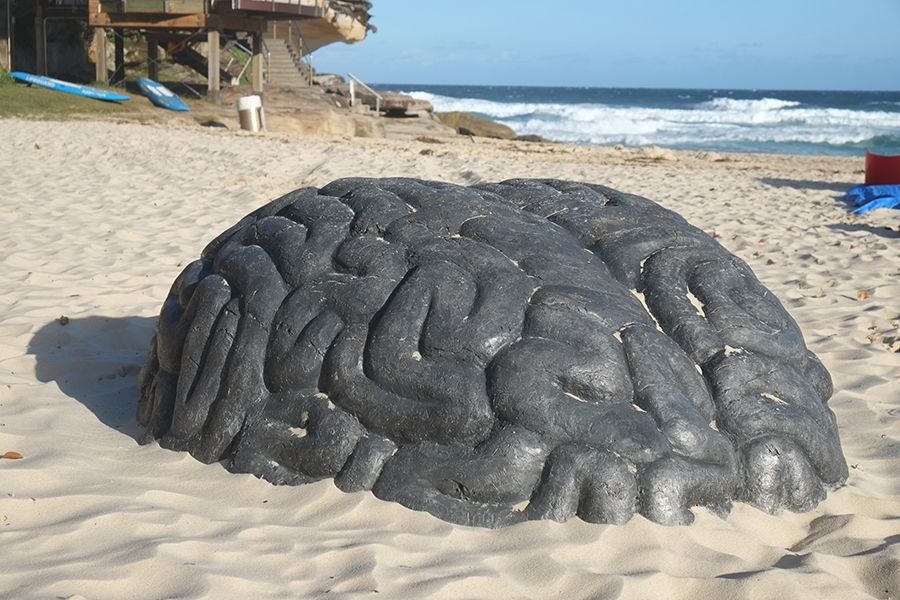
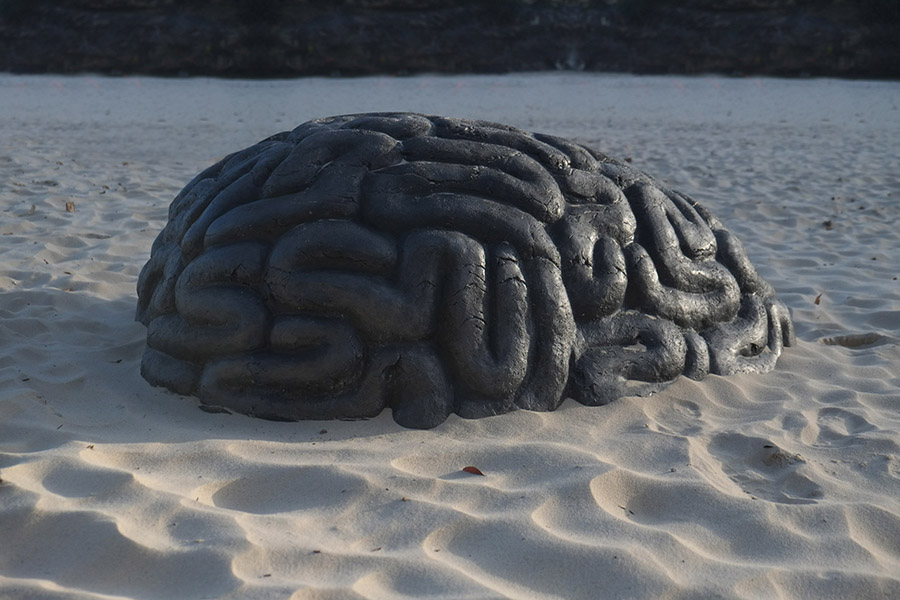
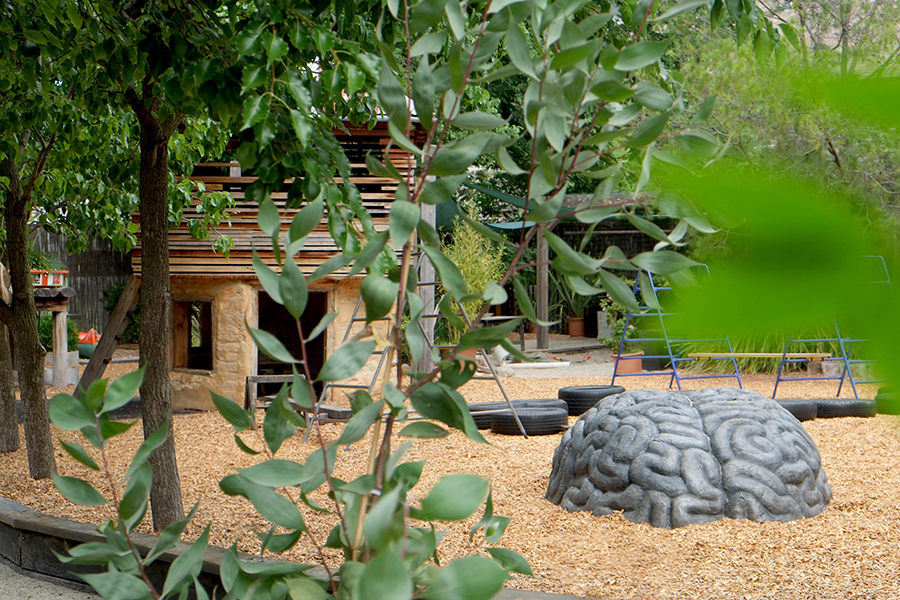
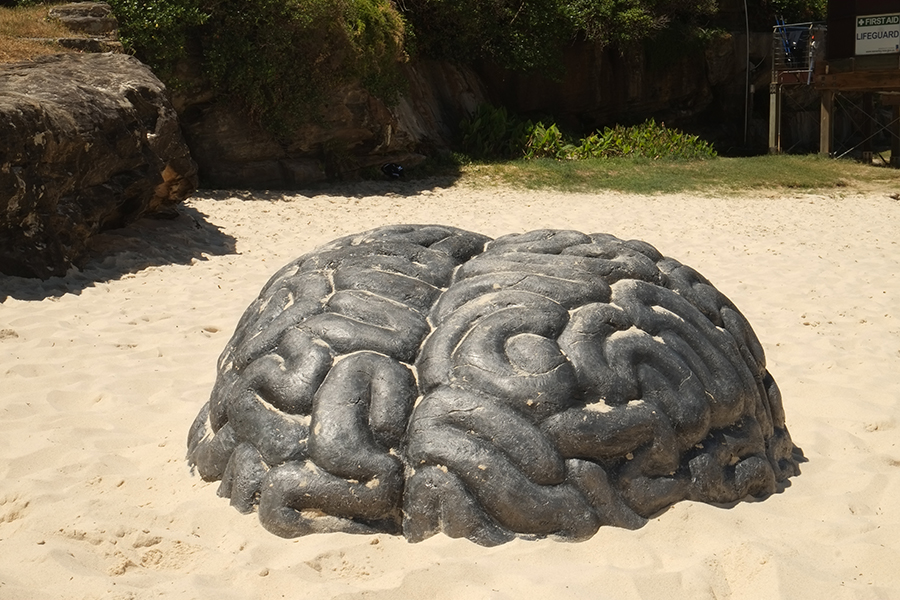
Piece of Mind
I have been thinking a lot about plastic, and how this human-made material is now a part of contemporary ecological cycles, it is in our waterways and has entered the food chain. Soft plastics are generally used once and thrown into landfill. I want to explore the possibilities of revaluing waste plastic by reconstituting it into sculptural form, turning this materials negatives (such as its durability and longevity) into positives. By partnering with leaders in the recycling industry I explored methods of transforming used plastics into sculptural form.
We have brought forth multitudes of new materials like plastic, that ecological systems must now deal with, on land, earth and sea. If we think in evolutionary timelines, it is happening at a rapid pace. If we acknowledge that we live in the age of Anthropocene, where human interventions are effecting earths systems, we must also recognise that as the most intelligent animal, the human is placed as custodian of the pivotal partnerships within ecosystems that all living communities occupy. Our waste is a part of the earths system, the cycle of matter and energy that we depend upon.
I was challenged by what the kooky philosopher Slavoj Žižek said, while standing in a pile of trash at a rubbish dump, he said … “a true ecologist must love all this stuff”. I have forced myself to look. It was while living in the Netherlands completing a Masters, studying ‘place’ under Lara Almergui that I followed the local trash trail, visiting waste plants in industrial sites. The experience left me wanting to reconsider the practice of placing long lasting plastics into landfill or burning single use items.
I have long been concerned with the material required to make outdoor sculpture, and struggled with the dilemma of making strong, durable, long lasting sculptural works on a large scale, while being sensitive to ecological cycles. Re-using existing materials, such as the mountains of plastic waste currently going into landfill in alarming quantities, seems like a no brainer!
NewTecPoly have an Australian first extruder that has the ability to recycle co-mingled soft plastics. I have been welcomed into the initial experimental phase of this material research. There are many unknowns and challenges in creating sculptural work with this reconstituted waste plastic, and much experimentation required.
The brain is the central control device that makes us who we are, and it is the size of a human brain that differentiates us from other animals. All animal brains assess their environmental conditions and adjust their behaviours to ensure survival. The human brain is capable of the unique ability of imagination – to imagine something that does not exist, and the cognitive ability to make it happen. This sculptural brain represents a shift in thinking about materiality and ecology.
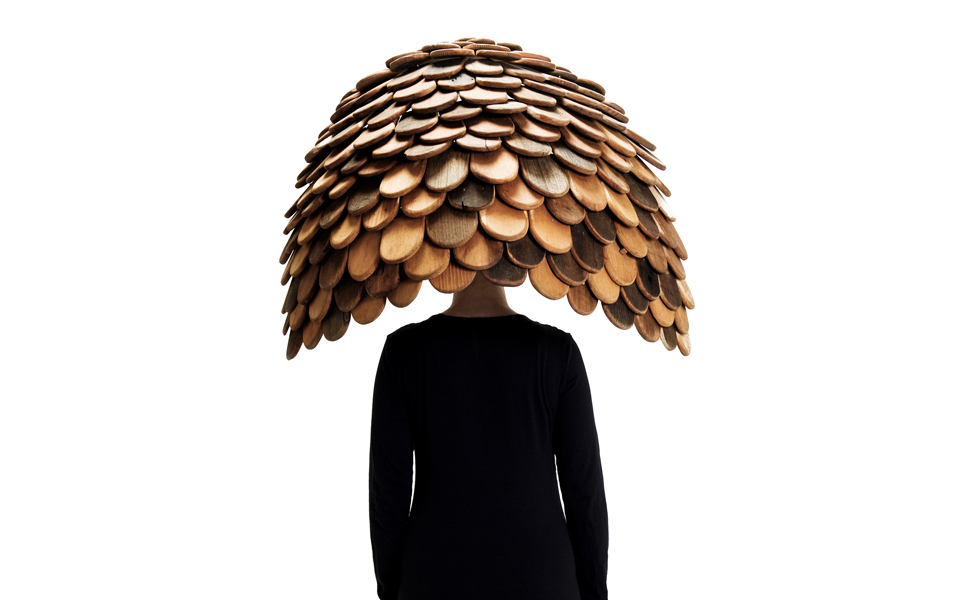
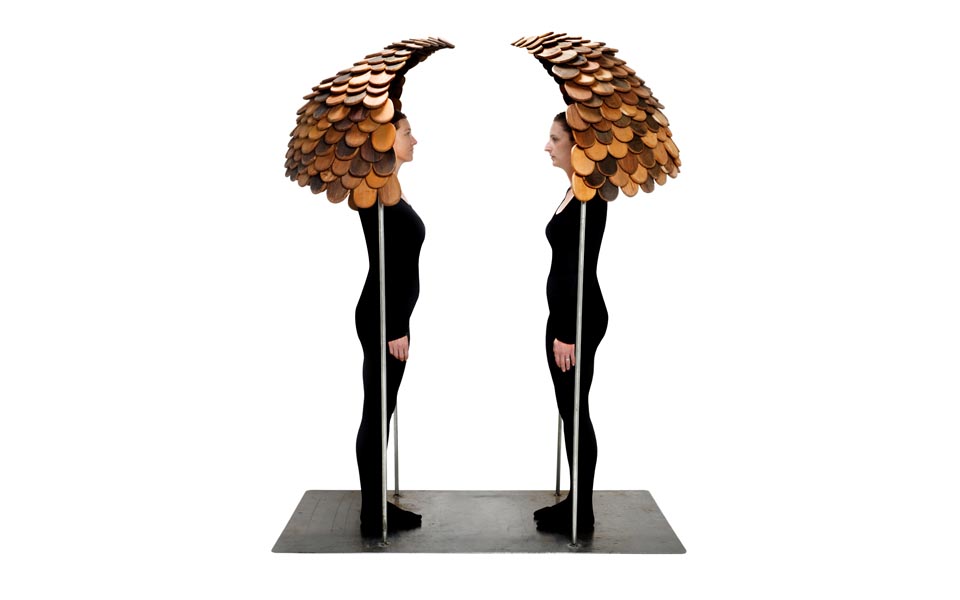
Becoming Animal
The transformation of aesthetic patterns found in the natural world alludes to a bird, a fish, a set of wings – the animal. The symbol reflects on the ancient and contemporary relationship between human and animal. It is a space to contemplate the idea of ‘becoming’, where anthropocentrism yields to sentient beings and we can consider our world a shared habitat.
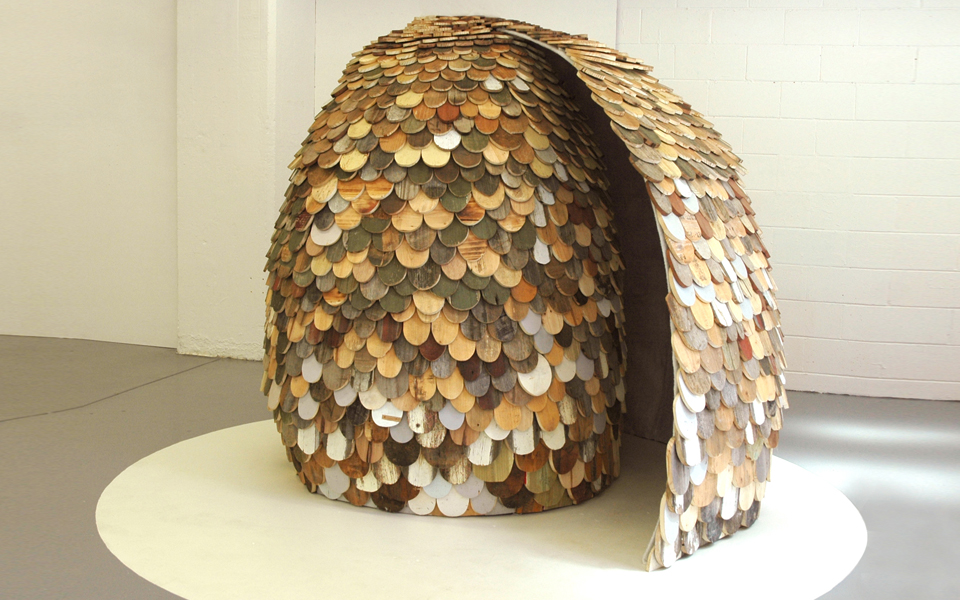
Searching for Evidence of the Evolution of Beauty
This work is an exploration of the momentous change of philosophical outlook that came with Darwin’s, Theory of Evolution.
A fascination for the evocative properties of natural and salvaged art materials was an integral part of the realisation of this work. Each piece of reclaimed wood is unique in its origin, colour and texture, they have all combined to create a surface that casts back a reflection of the history and potential in the detritus of urban life. Characterised by the passage of time, and the effects of natural elements, this material provided its own unique beauty and challenges. The organic form reflects a fascination for the patterning of plant design and animal skin. This work engages the viewer by inviting exploration into its intimate interior.
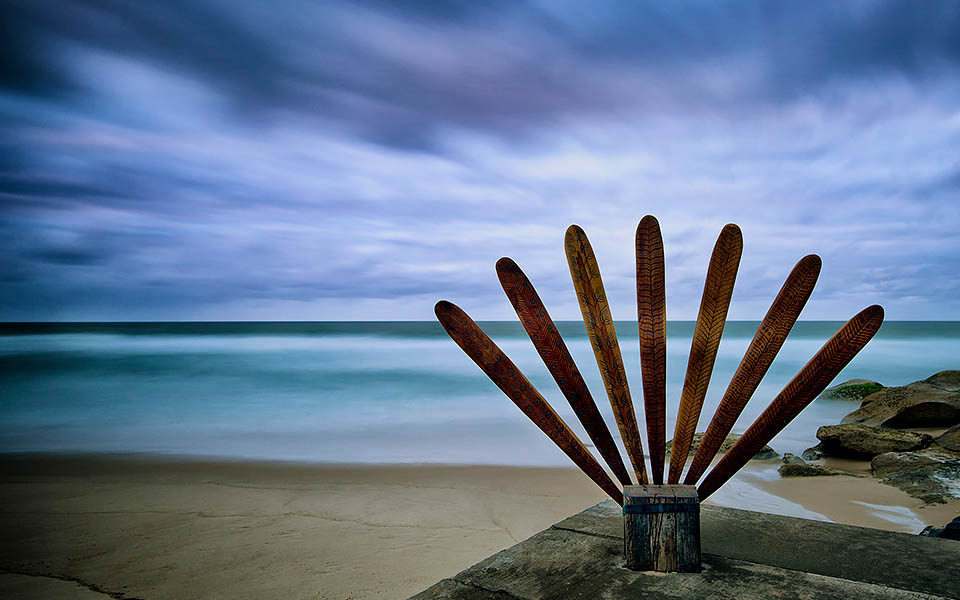
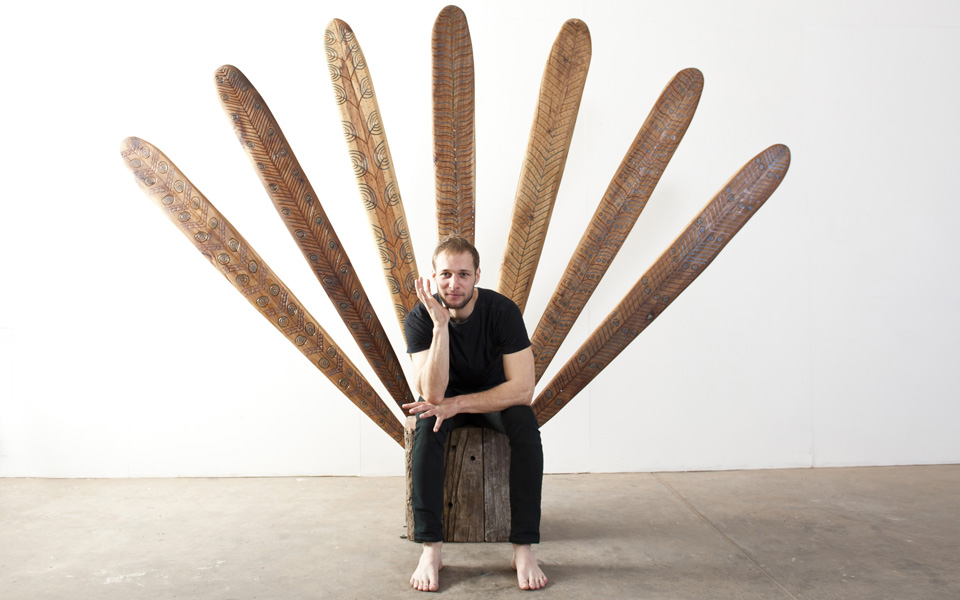
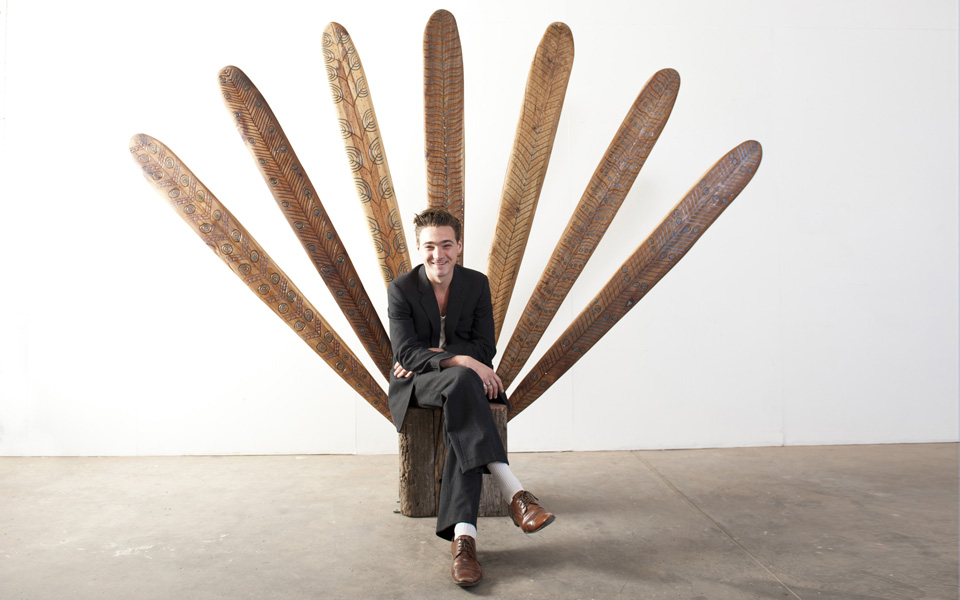
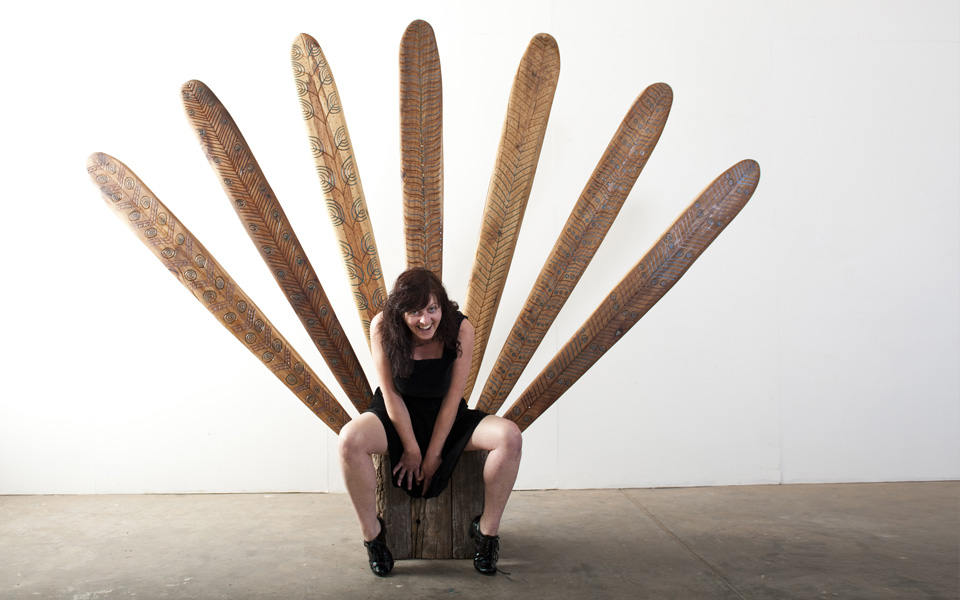
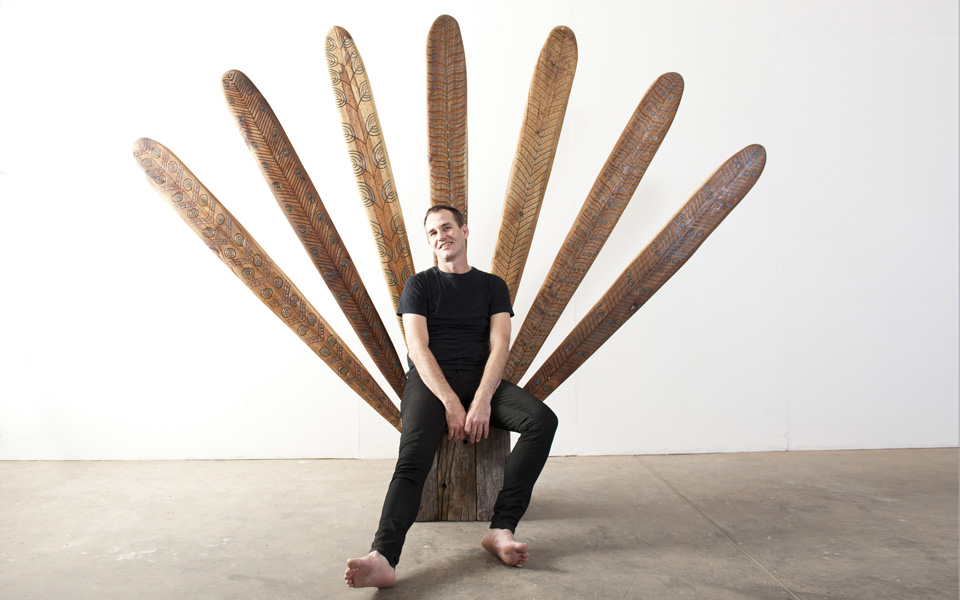
A Tale of Romance
This playful work turns the mimicry of the bird’s mateship dance over to the human visitor. In a world of extreme body imaging it is good to reflect upon the male of the bird kingdom who hold the aesthetic responsibilities… and the extremes they take it to.
The evolution of sexual selection can produce qualities that reduce the ability to escape from predators where aesthetic features make a creature more conspicuous and slower. According to the theory of sexual selection, ornamental features can develop to the point at which the disadvantages of being caught by a predator outweigh the advantages of being selected by a partner. The peacock is a prime example of evolutionary choices of beauty over fear, the tail restricts the ability to fly but is a winner with the ladies. A clear case of form over function. An evolutionary example of love at all costs. A romantic tail/tale.
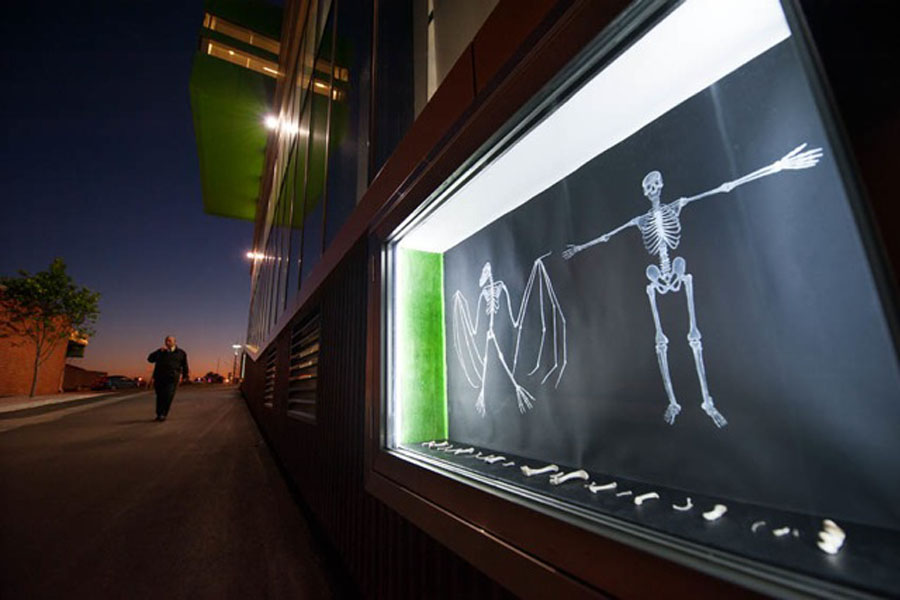
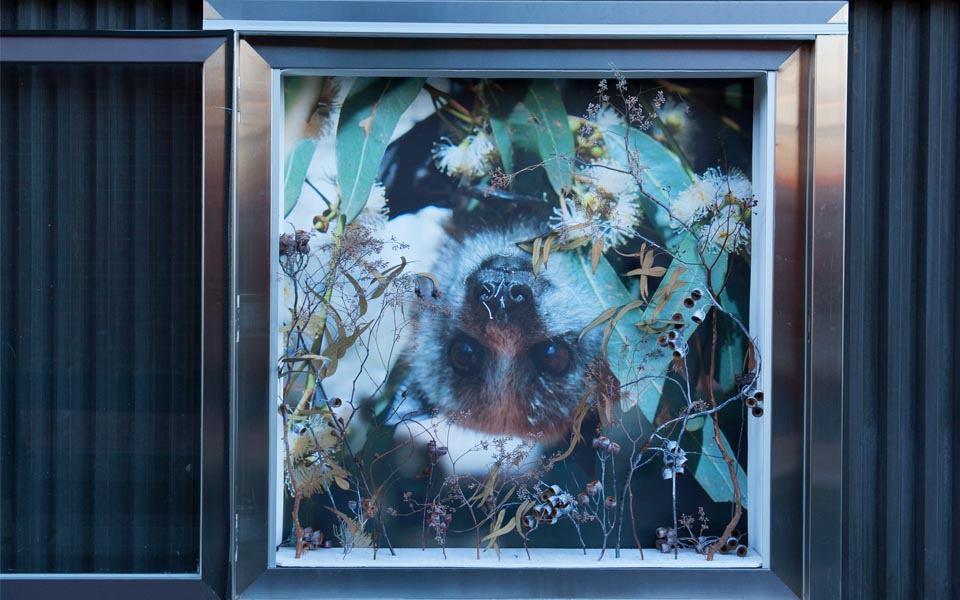
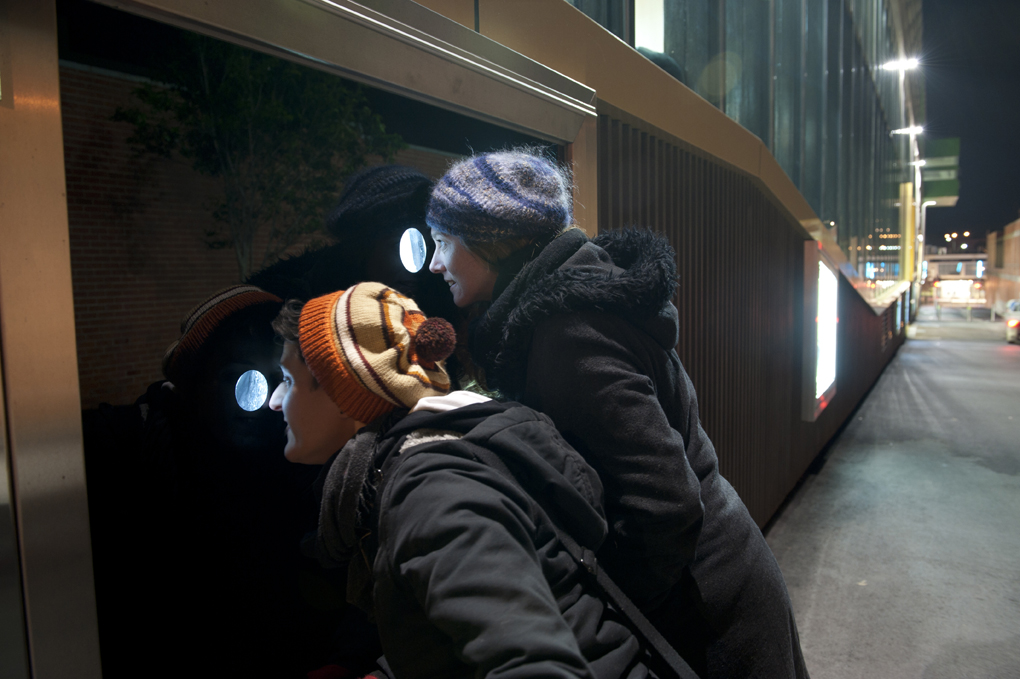
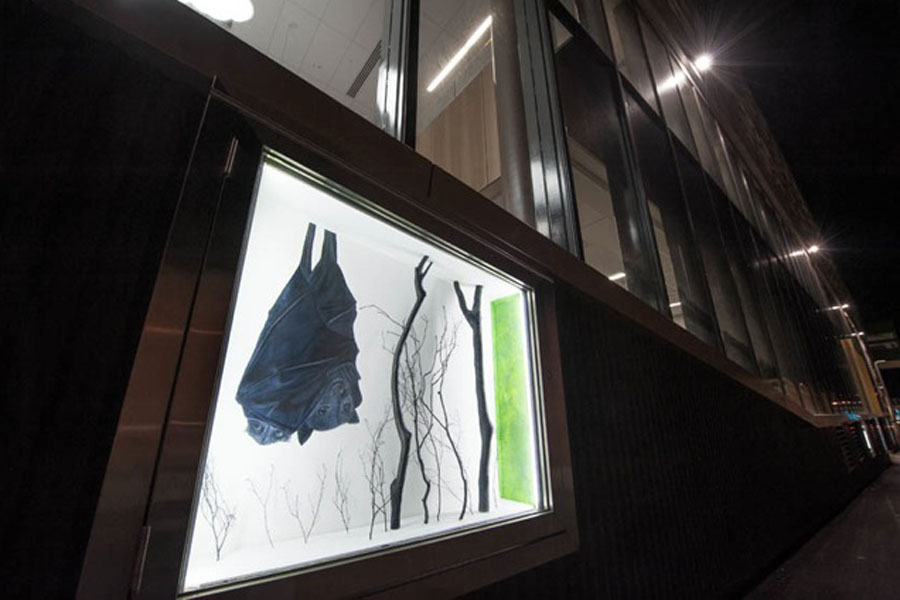
Nocturnal pilgrimage
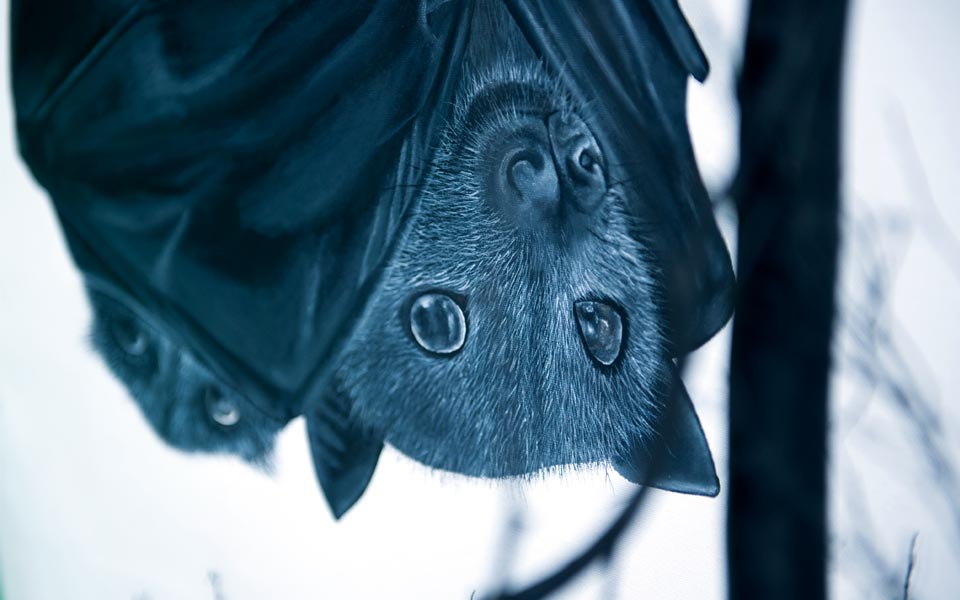
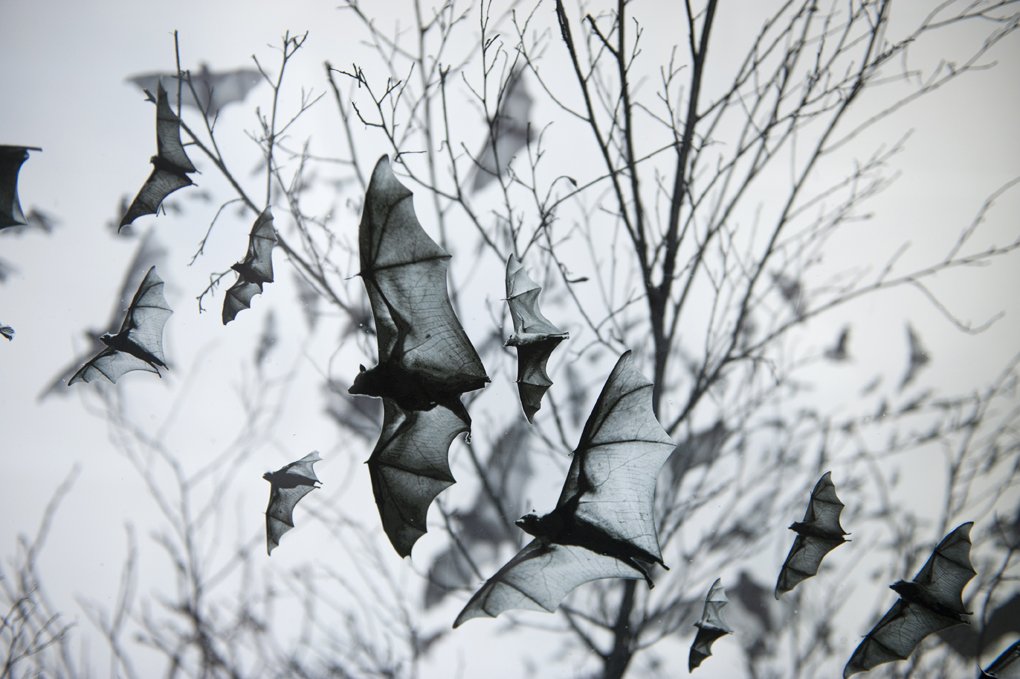
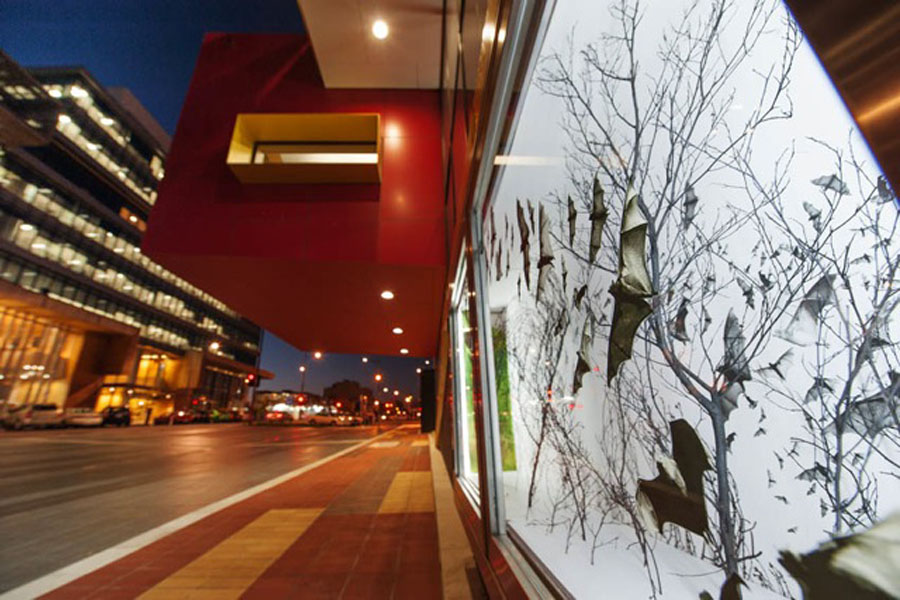
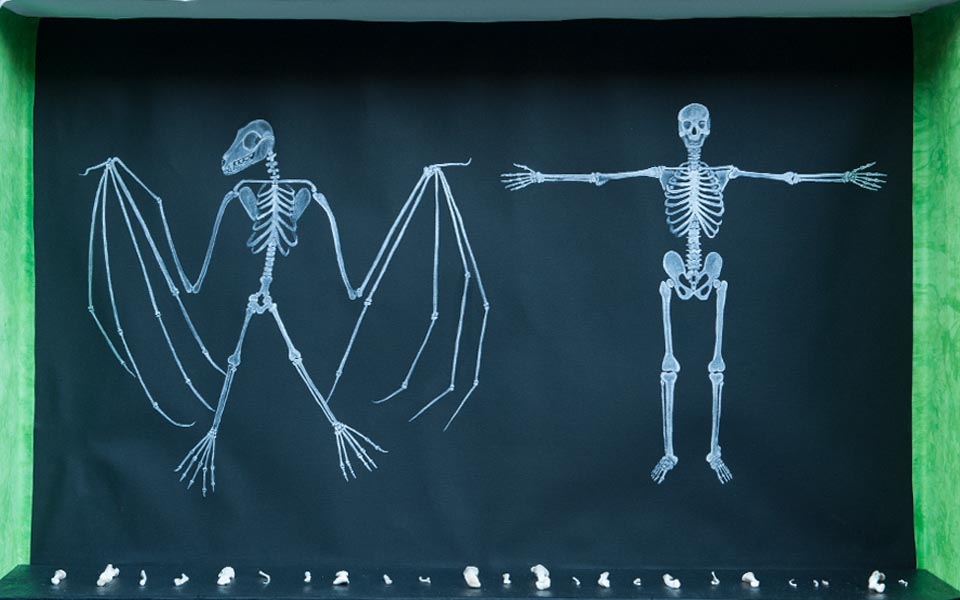
My research into fruit bats was presented as a public exhibition within seven large vitrines built in to the new Dandenong Municple Building. The installations consisted of painting, sculpture and photography for the inaugural Light-box Commission.